


Key cautions
- Avoid medicinal H. arenarium with daisy-family allergy or bile-duct, gallstone or liver problems; pregnancy, breastfeeding and children need professional advice.
- Do not ingest essential oil or apply cosmetic oil/hydrolate to open or infected skin.
What’s inside
The preparation selects the chemistry: water preparations, distilled oil and other extracts carry different mixtures. Plant compounds should be described by species and extraction method rather than treated as dietary nutrients.
EMA: Assessment report on Helichrysum arenarium flowers · Lemaire et al. (2023): Corsican H. italicum oil and neryl acetate in human skin explants
Constituents follow the extraction method
Flower flavonoids and phenolic acids characterize H. arenarium preparations. Distilled H. italicum oil instead concentrates volatile compounds; one Corsican research oil was neryl-acetate-rich, but that is not every commercial batch. Hydrolate contains water-compatible distillation constituents in a much more dilute aqueous matrix. Solvent and CO2 extracts can retain different, less volatile constituents.
EMA: Assessment report on Helichrysum arenarium flowers · Lemaire et al. (2023): Corsican H. italicum oil and neryl acetate in human skin explants · Bezek et al. (2022): H. italicum hydrosol composition and laboratory antimicrobial testing · Lemaire et al. (26 August 2026): Supercritical CO2 extract from H. italicum distillation co-products
Flower phenolics
EMA identifies isosalipurposide, naringenin-related flavonoids and phenolic acids such as caffeic, chlorogenic and ferulic acids in H. arenarium flowers. These are plant constituents, not standardized vitamin or mineral servings. Their presence in the flower does not specify the amount in a prepared cup.
What the extraction names mean
Steam distillation separates a volatile essential oil from the condensed distillation water, called hydrolate or hydrosol. A solvent extract or a supercritical CO2 extract is another material again; a macerated carrier oil is not a distilled essential oil. Those names matter when comparing a cosmetic label with a research paper.
Lemaire et al. (2023): Corsican H. italicum oil and neryl acetate in human skin explants · Bezek et al. (2022): H. italicum hydrosol composition and laboratory antimicrobial testing
Uses in brief

- H. arenarium flowers: traditional adult digestive tea for fullness and bloating.
- H. italicum: fragrance and skin conditioning; early skin research depends on the exact oil, hydrolate or extract tested.
History, folklore and reported uses
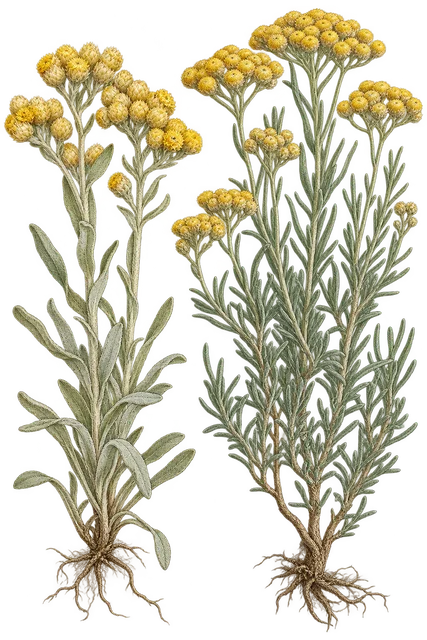
Two species and several materials
The EMA digestive assessment is specifically H. arenarium flowers. H. italicum is a related but distinct species represented by oils, hydrolates, infusions and extracts in research. Even within H. italicum, geography and plant populations affect volatile profiles. Common names such as immortelle and everlasting cannot identify a dose-equivalent preparation.
EMA: Sandy everlasting flowers, traditional digestive use · Melito et al. (2013): Genetic and metabolite diversity of Sardinian H. italicum populations
European flower-tea history
The name helichrysum opens two related but distinct herbal cupboards. Sandy everlasting, Helichrysum arenarium, belongs to a European flower-tea tradition. EMA’s assessment describes water preparations and a history of digestive use, particularly visible in central and eastern European herbal medicine. The small yellow flower heads entered teas intended for fullness, bloating and sluggish digestion, carrying their own apothecary identity as Helichrysi flos.
EMA: Sandy everlasting flowers, traditional digestive use · EMA: Assessment report on Helichrysum arenarium flowers
Mediterranean immortelle traditions
Mediterranean immortelle, Helichrysum italicum, has another regional history. An ethnopharmacological review documents uses in Italy, Spain, Portugal and Bosnia and Herzegovina, including respiratory, digestive and skin complaints. Its aromatic character later became important in essential oils and cosmetic products. The names “everlasting” and “immortelle” can make these traditions sound interchangeable, yet a sandy-everlasting flower tea is not the same material as immortelle oil. Reading the two stories side by side restores the useful local detail: different species, different preparations and overlapping ideas of plant-based care, rather than one universal helichrysum remedy.
Viegas and colleagues (2014): Helichrysum italicum, from traditional use to scientific data
Reading the historical preparations
The accounts below describe recorded practices rather than treatment instructions. An infusion steeps plant material in water; a mouth rinse is a local oral application rather than a swallowed tea. Catarrh means a build-up of mucus in the nose or throat. The locations and plant parts help keep a flower infusion distinct from a modern essential-oil product.
Viegas and colleagues (2014): Helichrysum italicum, from traditional use to scientific data · Viegas et al. (2014): Full review and regional traditional-use table, author-uploaded copy
Digestive flower teas
Central and eastern European herbal practice used Helichrysum arenarium flower preparations for fullness and bloating. Mediterranean records also describe H. italicum flower infusions for digestive complaints, but these are separate species traditions.
EMA: Sandy everlasting flowers, traditional digestive use · Viegas et al. (2014): Full review and regional traditional-use table, author-uploaded copy
Cough and catarrh remedies
A 1999 survey on Giglio, Italy, recorded H. italicum leaves and flowering tips in infusions and vapour preparations for coughs, colds and throat complaints. Other Italian surveys recorded flower teas for cough.
Viegas et al. (2014): Full review and regional traditional-use table, author-uploaded copy · NHS Royal Devon and British Burn Association: Steam inhalation burn warning
Toothache and mouth rinses
Spanish ethnobotanical records from Granada and Ibi describe H. italicum flower infusions used as mouth rinses for toothache and oral care. This local-use tradition is distinct from digestive tea.
Viegas et al. (2014): Full review and regional traditional-use table, author-uploaded copy · NHS: Toothache and when to seek dental care
Inflamed skin and wound care
Spanish records compiled by Viegas describe H. italicum flower infusion applied externally for skin inflammation, and powdered flowering aerial parts for wounds. The records preserve several preparations of the flowering herb.
Viegas et al. (2014): Full review and regional traditional-use table, author-uploaded copy
Sleeplessness and headache folklore
A 2009 survey in Liguria recorded fumes from H. italicum flowers and leaves for sleeplessness and headache. The historical fumigation practice is documented here without recommending smoke exposure or hot-steam inhalation.
Viegas et al. (2014): Full review and regional traditional-use table, author-uploaded copy
Dried flowers, wreaths and garlands
Singapore NParks records Helichrysum italicum leaves used in wreaths and garlands and flowers that retain their yellow colour after drying. This decorative use belongs specifically to Mediterranean immortelle, not automatically to H. arenarium or every plant called everlasting.
Identity & detailed reference
Identity
Helichrysum is a genus in Asteraceae, not one interchangeable remedy. H. arenarium (L.) Moench, sandy everlasting, supplies the flowers in the European traditional digestive-tea monograph. H. italicum (Roth) G. Don, immortelle, supplies aromatic oils and various extracts used in cosmetic research.
Ingredient details, preparation and research
Source plant or material
H. arenarium dried flower heads for the EMA digestive preparation. H. italicum flowers/flowering aerial parts for oil and hydrolate, with plant extracts depending on the named part and process. The two species should not be substituted solely because both are called everlasting.
Plant family / material: Asteraceae (daisy family).
Forms and route
H. arenarium dried, cut flower heads for a labeled infusion or decoction. H. italicum flowering aerial parts may yield steam-distilled essential oil, water-based hydrolate/hydrosol, or solvent/CO2 extracts; some identified preparations are teas. A macerated carrier oil is also distinct from a distilled essential oil. Confirm species, part, extraction and intended route.
Food sources
A correctly identified, food- or medicine-labeled flower tea is an oral preparation. Fragrance oils, cosmetic extracts and hydrosols are not presumed suitable to drink. An aromatic garden plant or a common name alone does not establish edible identity.
Vitamins and minerals
These preparations have no standardized vitamin/mineral contribution to rely on. Polyphenols and aromatic terpenes are not essential vitamins. A topical oil supplies no dietary nutrition; tea does not replace calcium or vitamin D sources if dairy intake is reduced.
Absorption and preparation
Hot water extracts a different mixture from steam distillation or CO2 extraction. Reliable human pharmacokinetic information for the traditional flower tea and consumer topical oils is limited. The reviewed evidence establishes no general fat-pairing, fasting or absorption-booster routine. A laboratory cell directly exposed to an ingredient does not demonstrate penetration from a retail skin product.
Practical preparation
Use a correctly identified H. arenarium tea product and its preparation directions; do not substitute H. italicum oil for the flowers. For skin care, choose a finished, labeled formulation that identifies the species and material. Hydrolate is a distillation water, not oil drops shaken into water. Water-containing sprays need suitable preservation and stability testing; no shelf-stable homemade spray or unvalidated oil-drop dilution is supplied.
Combination notes
Rosehip, jojoba, coconut oil and multi-ingredient creams change the vehicle and may contribute effects of their own. A blend study does not identify the contribution of every ingredient. Mixing digestive herbs or oils has not established an absorption advantage. Adding essential oil to water does not reliably disperse it or reproduce a hydrolate.
Traditional and reported uses
- Traditional European digestive use: H. arenarium flower tea for fullness and bloating. EMA recognizes longstanding use, not a well-established clinical treatment or a proven remedy for gallstones.
- Cosmetic and aromatic use: H. italicum oil and extracts are used for fragrance and skin conditioning. Skin-barrier and hydrolate wound-repair findings are mainly laboratory evidence, with no automatic transfer between preparations.
- Human cosmetic research: a small 2025 essential-oil serum study and a 2026 supercritical-CO2-extract study reported wrinkle improvements with their specific preparations. Short duration, small samples and formulation/design limits prevent broad claims that immortelle rejuvenates skin.
- Bruise, scar and wound traditions have generated clinical reports, but these do not establish a reliable cure or justify putting undiluted oil on damaged skin. Digestive-tea research does not show that helichrysum replaces lactase for lactose-related gas.
Contraindications and cautions
- For H. arenarium medicinal tea, avoid with Asteraceae allergy. EMA does not recommend use with bile-duct obstruction, cholangitis, liver disease or gallstones because bile secretion may be stimulated.
- EMA does not recommend medicinal H. arenarium during pregnancy/breastfeeding or under age 18 because safety data are inadequate. Worsening symptoms or digestive symptoms persisting beyond two weeks need assessment.
- Do not swallow helichrysum essential oil or add it to drinking water as a homemade digestive remedy. Topical oil can cause irritation or allergy; use a properly formulated skin product as labeled, away from eyes and mucous membranes.
- Do not put cosmetic essential oils or hydrolates on open wounds, active burns, fresh incisions or infected skin. Unexplained bruising, persistent swelling or poor healing needs medical assessment. A case report is not a validated home-treatment protocol.
- Species-specific monograph precautions cannot establish safety for a different extract or route. Pregnancy, breastfeeding, children and regular medicines warrant professional review before medicinal essential-oil or extract use; absence of interaction reports is not proof of no interactions.
Similar items and how they compare
- Chamomile, German
Both are Asteraceae flower preparations with traditional digestive uses.
Chamomile is Matricaria chamomilla; helichrysum is a different genus. Their chemistry, labeled preparations and precautions are not interchangeable.
- Helichrysum italicum essential oil
Often sold under the same broad helichrysum or immortelle name.
A concentrated volatile oil from H. italicum is not the H. arenarium flower tea assessed by EMA and is not a substitute for it.
Traditional digestive role and what it cannot show
EMA recognizes adult H. arenarium flower tea for digestive fullness and bloating on traditional-use grounds. Proposed bile-flow and smooth-muscle effects help explain the historical rationale but do not establish treatment of gallstones or lactose maldigestion. Lactose intolerance involves limited lactose digestion; lactose reduction, lactose-free products or suitable lactase address that mechanism more directly.
The small human infusion study
A 2022 comparative study had 27 completers with metabolic-syndrome traits and compared H. arenarium with H. italicum infusions for four weeks. Digestive-symptom and biological changes were reported, but there was no placebo group and no lactose-intolerance test. EMA’s 2023 review considered the small infusion reports insufficient to revise the traditional monograph.
Skin-barrier oil findings are ex vivo
Lemaire’s 2023 study exposed excised human skin to a characterized Corsican oil or neryl acetate and measured barrier-related genes, lipids and proteins. That is mechanistic evidence, not a trial showing clinical recovery from eczema, wounds or aging after ordinary cosmetic use. The work was industry-supported and concerned a particular chemical profile.
Hydrolate, fibroblasts and collagen
Serra’s 2023 experiments used H. italicum hydrolate with cultured skin stem cells and fibroblasts, including a scratch model. The 2024 follow-up used a dynamic cell-culture system and measured collagen-related responses. These are promising laboratory observations, not human wound-healing trials; they cannot be transferred to essential oil or used to claim that a spray regenerates skin.
Human cosmetic evidence: finished cream and oil serum
A 2020 study of a cream containing H. italicum extract, melatonin, carnosine and other ingredients included four open-label trials totaling 117 people. Outcomes belong to the whole cream. Separately, Choi’s 2025 four-week, 21-person study tested a 3% H. italicum flower-oil serum against jojoba oil and reported improved wrinkle measurements. This is small, short-term, formulation-specific evidence; the studied concentration is not a home eye-area recipe.
A newer CO2 extract study is a separate preparation
An August 2026 industry-associated study tested a 0.1% supercritical CO2 extract of post-distillation H. italicum material. Its randomized treatment-sequence comparison with 0.1% retinol analyzed 47 completers across two short treatment periods. Both formulations improved wrinkle scores. The active comparator, absence of a vehicle-only clinical arm, possible carryover and short follow-up limit interpretation. It does not establish general equivalence to retinoids or efficacy of steam-distilled essential oil.
Wounds, bruises and scars: weak clinical support
A 2024 three-case wound report describes apparent improvement, but lacks a control group and has inconsistent preparation reporting between its summary and individual cases. Irritation attribution is uncertain. It cannot establish accelerated healing, infection prevention or a safe concentration. Traditional bruise/scar use and laboratory antimicrobial findings do not justify replacing appropriate wound care or applying oil to fresh surgical skin.
Safety must follow species and route
The H. arenarium monograph cautions against medicinal use in specified biliary/liver conditions and excludes populations lacking adequate safety data. Those details cannot certify an H. italicum oil as safe to swallow. Concentrated essential oils can irritate skin and cause poisoning if misused; keep them away from children. Reported tolerance in a small cosmetic study does not settle long-term sensitization or pregnancy safety.
Preparation, nutrition and absorption limits
No human evidence reviewed validates a universal absorption-enhancing food pairing for these preparations. Direct cell exposure is different from delivery through intact skin. Nutrient claims require actual serving-based composition. A hydrolate or tea used in a stored cosmetic also needs appropriate microbial protection; laboratory activity against selected microbes is not proof that the finished product preserves itself.
Entry sources
- EMA: Sandy everlasting flowers, traditional digestive use
- EMA: Final herbal monograph on Helichrysum arenarium flowers (2016)
- Petelin et al. (2022): Comparative Helichrysum infusion study in adults with metabolic-syndrome traits
- National Capital Poison Center: Essential oils can be poisonous when misused
- EMA: Assessment report on Helichrysum arenarium flowers
- EMA (2023): Helichrysum arenarium review addendum; no monograph revision
- Lemaire et al. (2023): Corsican H. italicum oil and neryl acetate in human skin explants
- Serra et al. (2023): H. italicum hydrolate in cultured skin stem cells and fibroblasts
- Serra et al. (2024): Hydrolate in a dynamic laboratory skin-wound model
- Granger et al. (2020): Multi-ingredient night cream, ex-vivo and open-label human studies
- Choi, Lee and Bae (2025): H. italicum oil serum and a four-week human wrinkle study
- Lemaire et al. (26 August 2026): Supercritical CO2 extract from H. italicum distillation co-products
- Wijayadi and Pratiwi (2024): Three-case wound report, internally inconsistent preparation reporting
- Melito et al. (2013): Genetic and metabolite diversity of Sardinian H. italicum populations
- Bezek et al. (2022): H. italicum hydrosol composition and laboratory antimicrobial testing
- NIDDK: Diet and nutrition for lactose intolerance
- FDA: Cosmetic GMP guidelines, preservation testing and laboratory controls
- Ananda Apothecary (July 2026): Helichrysum research index; commercial source used for leads
- FDA: Daily Value on the Nutrition and Supplement Facts labels
- Singapore NParks: Helichrysum italicum
Reference entry 104 · Recorded content review: 2026-10-05 · Review scope and dates