


Key cautions
- Cosmetic argan oil is not for eating
- Argan allergy can be serious, including after skin contact
- Refining can reduce residual proteins, but evidence for other refined oils does not certify a particular argan product.
- Read the full ingredient list, especially in scented serums and mixtures, because other ingredients may affect tolerance.
What’s inside
Argan oil is chiefly triglycerides, fats built from fatty acids. Oleic and linoleic acids are prominent, alongside smaller palmitic and stearic fractions. Its minor constituents include tocopherols and plant sterols such as schottenol and spinasterol. Pressing out the oil does not carry over the whole kernel’s protein and fiber profile.
Sabiri et al. (2023): Composition of argan oils from a plantation and two natural forest stands
Which oil was measured?
The 2023 composition study used mechanically cold-pressed oil from unroasted kernels collected at one plantation and two natural forest stands. Its fatty-acid proportions, sterol fractions and tocopherol concentrations describe those samples. Percentages within a compound family are not percentages of the entire bottle, and milligrams per kilogram of oil are not amounts per spoon.
Sabiri et al. (2023): Composition of argan oils from a plantation and two natural forest stands
Composition and processing
A 2011 primary study compared oils from roasted kernels with cosmetic oil from unroasted kernels. The 2023 comparison of three geographic sources measured an oleic/linoleic-rich oil with characteristic sterols and substantial gamma-tocopherol. A 2024 experiment specifically used subquality kernels for cosmetic-oil refining research; bleaching/deodorization altered minor compounds and accelerated-storage stability. Its results cannot be used as the nutrient label of every culinary argan oil or as an exact room-temperature shelf life.
Harhar et al. (2011): Argan kernel roasting time, oil composition and oxidative stability · Sabiri et al. (2023): Composition of argan oils from a plantation and two natural forest stands · Asbbane et al. (2024): Physical refining and stability of argan oil from subquality kernels
Vitamin E: calculate alpha, not total tocopherols
The 2023 samples contained total tocopherols of 758.47, 662.80 and 749.43 mg/kg; alpha fractions were 4.24%, 7.04% and 4.49%. Multiplying each pair and scaling to a weighed 10 g portion gives 0.322, 0.467 and 0.336 mg alpha-tocopherol. NIH bases vitamin E requirements on alpha-tocopherol, so the much larger gamma-rich total cannot be credited to that requirement. Product-specific analysis remains preferable.
Sabiri et al. (2023): Composition of argan oils from a plantation and two natural forest stands · NIH Office of Dietary Supplements: Vitamin E, alpha-tocopherol, absorption and Daily Values
Uses in brief

- Moroccan food tradition and modern culinary oil
- Skin softening and hair conditioning; preliminary hydration research
- Hair lengths: argan oil may give a glossy, smoother finish; laboratory findings do not justify guaranteed strengthening or regrowth.
History, folklore and reported uses
Extraction learned within families
In southwestern Morocco, argan oil is inseparable from the work and knowledge of the communities living among the trees. UNESCO’s 2014 heritage inscription describes women, and to a lesser extent men, carrying out the sequence of collecting fruit, drying it, removing the pulp, sorting kernels, milling and working the paste. Local craftspeople make the distinctive hand mills. Much of the skill is learned by watching and practising within families, especially through the knowledge passed from mothers to daughters.
UNESCO (2014): Argan, practices and know-how concerning the argan tree
Wedding gifts and festive dishes
The finished oil moves through several parts of life: cooking, cosmetic care and traditional medicine. It is also given at weddings and used in festive dishes, so its value exceeds the contents of a modern beauty bottle. UNESCO treats the linked skills, tools, recipes and relationships as the heritage itself. That makes a richer story than a claim of timeless cosmetic perfection: argan oil carries the labour of extraction, the social occasions on which it is shared, and the continuity of a particular Moroccan woodland culture.
UNESCO (2014): Argan, practices and know-how concerning the argan tree
A tree within a working landscape
FAO describes the Ait Souab–Ait Mansour area as a linked system of farming, trees and livestock. Terraces retain soil and rainwater, while underground reservoirs help communities through dry periods. Oil production sits within these livelihoods rather than standing apart as a beauty industry: the tree supplies income, and extraction has also been a social occasion for women working together.
FAO (2021): The Moroccan landscape, traditions and communities behind argan and its oil
Skin hydration and blemish care
An ethnobotanical survey in Chtouka Ait Baha and Tiznit records argan oil rubbed onto skin for everyday care, freckles and acne pimples. It places these uses within the knowledge held by local households.
Barkaoui et al. (online 2022; volume 2024): Argan ethnobotany and foods in the Western Anti-Atlas
Hair and nail grooming
The survey describes argan oil in hair care and discusses its traditional use for brittle nails. These beauty practices accompany the much better-known culinary bottle.
Barkaoui et al. (online 2022; volume 2024): Argan ethnobotany and foods in the Western Anti-Atlas
Rubbing sore muscles and rheumatic joints
The survey’s oil-specific record lists external friction for muscle tears and rheumatic pain. It is a Moroccan rubbing-oil tradition, distinct from preparations of argan leaves or crushed kernels.
Barkaoui et al. (online 2022; volume 2024): Argan ethnobotany and foods in the Western Anti-Atlas
A stomachic and laxative
The same oil-specific record describes oral argan oil used as a stomachic and laxative. These are traditional digestive purposes recorded from local practice.
Barkaoui et al. (online 2022; volume 2024): Argan ethnobotany and foods in the Western Anti-Atlas
Fortifying foods and festive nourishment
In the Souss region, argan oil enriches amlou, labsis and barley-based tagoulla. Amlou, combining oil with almonds and honey, is also traditionally regarded as strengthening, including after childbirth.
Barkaoui et al. (online 2022; volume 2024): Argan ethnobotany and foods in the Western Anti-Atlas
Meals and the meaning of a portion
Labsis, a celebratory snack, accompanies celebrations and the completion of oil extraction; tagoulla is served for the Amazigh New Year, the new-year festival of North Africa’s Indigenous Amazigh communities. Nutrient measurements for these mixed dishes belong to the complete recipe, not to bottled oil.
Barkaoui et al. (online 2022; volume 2024): Argan ethnobotany and foods in the Western Anti-Atlas
Regional reading paths
These sourced notes describe cultivation, trade, food traditions or material history. A regional connection does not claim exclusive origin.
Africa
Native and traditional processing: southwestern Morocco.
Culinary oil and separately labeled cosmetic oil; preparation determines use.
Identity & detailed reference
Identity
Argan kernel fixed oil from Sideroxylon spinosum L. (syn. Argania spinosa (L.) Skeels), associated with Morocco. Cosmetic labels generally retain the INCI name Argania spinosa kernel oil.
Ingredient details, preparation and research
Source plant or material
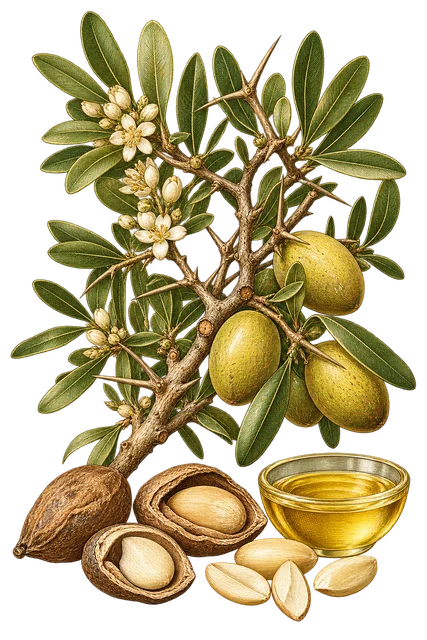
Sideroxylon spinosum L. (syn. Argania spinosa); oil expressed from kernels inside the hard fruit stones.
Plant family / material: Sapotaceae (sapodilla family).
Forms and route
Culinary argan oil, commonly from roasted kernels, and cosmetic oil, commonly from unroasted kernels; refined/deodorized oils and multi-ingredient skin or hair products also exist. Food quality and the labeled route matter more than a pure/natural marketing claim.
Food sources
Use only culinary argan oil. It can be used in dressings, as a finishing oil or with bread; traditional Moroccan preparations have their own food ingredients and allergy profiles. A cosmetic bottle is not a culinary substitute.
Vitamins and minerals
Argan oil supplies food fat but its total tocopherol content should not be called an equivalent vitamin E dose. In three oils analyzed in 2023, a weighed 10 g portion calculates to approximately 0.32–0.47 mg alpha-tocopherol, about 2–3% of the 15 mg Daily Value. Most tocopherols were gamma-tocopherol, which does not meet the vitamin E requirement. These are sample-specific calculations, not a standard serving or guaranteed label value; no spoon-weight conversion is assumed. It is not a meaningful source of the protein/fiber of whole kernels.
Absorption and preparation
Edible argan oil is digested as food fat; topical oil is used for local conditioning. Human hydration and elasticity measurements are not measurements of whole-body vitamin delivery, brain uptake or depth of penetration. No percentage bioavailability or claim of uniquely deep absorption is assigned.
Practical preparation
Choose a clearly labeled food or cosmetic product for the intended route. Store closed away from heat/light and follow its expiry directions. Refined or deodorized oil is a different product from a fragrant roasted-kernel culinary oil. For sensitive skin, introduce one finished product at a time rather than a multi-oil experiment.
Combination notes
In foods, argan can replace part of another fat without a special supplement pairing. In cosmetics, the complete formula determines tolerance and performance; adding essential oils is not necessary for conditioning. Plant sterols and tocopherols measured in oil are not standardized therapeutic supplement doses.
Traditional and reported uses
- FAO documents centuries of regional Moroccan production and use in cooking and skin/hair care.
- Cosmetic emollient and hair-conditioning use can improve softness, gloss and handling. This does not permanently repair split ends.
- Small studies measured hydration, elasticity and blood-lipid changes; these findings are preparation- and population-specific.
- Hair lengths: argan oil may give a glossy, smoother finish; laboratory findings do not justify guaranteed strengthening or regrowth.
Contraindications and cautions
- Do not eat cosmetic oil, hair serum or fragranced blends. Food-grade and cosmetic-grade products may differ in raw materials and processing.
- Avoid argan with a previous reaction. Published anaphylaxis after skin application means topical exposure is not automatically harmless. A home tolerance test cannot clear a known allergy.
- Do not infer either universal cross-allergy or universal safety from the word nut. Argan belongs to Sapotaceae; seek individual advice when severe food allergy is a concern.
- Do not use as sunscreen, an acne cure, a hair-regrowth treatment or a replacement for cardiovascular/diabetes medicines.
- For concentrated oral supplements or medicinal use during pregnancy/breastfeeding, safety and drug-interaction data are insufficient; ordinary culinary exposure is a different question.
- Refining can reduce residual proteins, but evidence for other refined oils does not certify a particular argan product.
- Read the full ingredient list, especially in scented serums and mixtures, because other ingredients may affect tolerance.
Similar items and how they compare
- Sweet almond oil
Both are kernel-derived skin/hair conditioning oils.
Almond is from Rosaceae and is generally more oleic-dominant, with alpha-tocopherol predominant; argan commonly has more linoleic acid and gamma-tocopherol.
- Sesame oil
Another culinary and cosmetic oil with substantial oleic and linoleic acids.
Sesame has its own lignans, flavor and allergy profile; it is not botanically related to argan.
- Argan press-cake or leaf extracts
Other preparations from the same tree appear in research.
They concentrate different constituents; cell or animal results from an extract do not establish the effect of food or cosmetic kernel oil.
Identity and Moroccan tradition
Kew now accepts Sideroxylon spinosum, with Argania spinosa as a synonym; the established cosmetic name remains widely used. FAO describes family-based oil production by rural women and longstanding cooking and skin/hair uses in the Ait Souab–Ait Mansour system. This is attributed cultural history, not clinical validation of all medicinal uses. The kernels provide a fixed fat, not a volatile essential oil.
Hydration: an informative but small study
In the 2014 report, 60 postmenopausal women were allocated to oral argan or olive oil for 60 days, and both groups applied cosmetic argan oil to one forearm. Instrument measurements favored argan exposure on selected hydration outcomes. There was no blinded topical placebo control, and oral/topical treatments overlapped. These limitations and the narrow population prevent a broad claim of proven eczema treatment or deep systemic absorption.
Elasticity is not proof of wrinkle reversal
A related 2015 report using the same-sized, closely matching oral-oil/one-forearm design found improved instrument-measured elasticity over 60 days. This is a small preliminary program rather than broad independent replication. Elasticity readings are not proof that argan prevents photoaging, removes wrinkles, repairs DNA or substitutes for sunscreen. Hair-conditioning use is also separate from a clinical hair-growth effect.
Dietary lipid research
An 86-person trial in type 2 diabetes with dyslipidemia compared 25 mL/day argan oil with 20 g/day butter at breakfast for three weeks. Lipids and an LDL-oxidation laboratory measure improved after the argan intervention. The different fats and food amounts, short duration and surrogate endpoints mean the study does not establish cardiovascular-event prevention or superiority over all unsaturated oils. Its measured mL dose is retained as reported, without inventing a gram conversion.
Allergy, route and realistic expectations
A 2021 case report documents anaphylaxis following cutaneous argan-oil use; it demonstrates possibility, not its population frequency. Avoid a previously reactive product and seek individual allergy advice rather than relying on a home skin trial. Oral safety cannot be inferred from cosmetic use, and limited trials do not define all drug interactions or medicinal pregnancy doses.
Absorption and everyday preparation
Ordinary dietary fat is broken down and absorbed through the digestive tract. Cosmetic emollience is a local effect, not evidence of delivering dietary nutrients through the skin. Keep food and topical products distinct and respect storage directions. A heat-accelerated laboratory deterioration test does not supply a household expiry date.
Hair care: cosmetic role and evidence limits
Hair-fiber laboratory evidence is mixed. One study tested argan-oil pretreatment before oxidative damage to excised hair; another comparative oil study reported increased fragility under some test conditions. These are shaft experiments, not human follicle-regrowth trials. A cosmetic finish can be useful without implying that every argan product strengthens hair or repairs all damage. Cosmetic conditioning can improve the feel or appearance of existing lengths; it is not evidence of new hair growth. Oils do not add water to hair: laboratory moisture studies address changes in water movement, not a universal “hydration” effect. Use a small amount of a tolerated hair product on lengths or ends according to its label, alongside conditioner and gentle detangling. Stop for irritation; persistent scalp itching, redness or loss needs assessment.
Entry sources
- Kew Plants of the World Online: Sideroxylon spinosum, synonym Argania spinosa and Sapotaceae
- FAO (2021): The Moroccan landscape, traditions and communities behind argan and its oil
- COSMILE Europe: Argania spinosa kernel oil, cosmetic ingredient roles
- Boucetta et al. (2014): Oral/topical argan oil and skin hydration in 60 postmenopausal women
- Boucetta et al. (2015): Dietary/cosmetic argan oil and postmenopausal skin elasticity
- Ould Mohamedou et al. (2011): Argan oil versus butter in type 2 diabetes with dyslipidemia
- de Las Marinas Alvarez et al. (2021; online 2020): Anaphylaxis after cutaneous application of argan oil
- Harhar et al. (2011): Argan kernel roasting time, oil composition and oxidative stability
- Sabiri et al. (2023): Composition of argan oils from a plantation and two natural forest stands
- Asbbane et al. (2024): Physical refining and stability of argan oil from subquality kernels
- Anaphylaxis UK: Plant-based oils, refining and food-allergy cautions
- American Academy of Dermatology: How to test skin-care products
- NIDDK: Your digestive system and how it works
- NIH Office of Dietary Supplements: Vitamin E, alpha-tocopherol, absorption and Daily Values
- Hair-fiber study (2022): Argan-oil pretreatment and oxidative damage
- Cosmetics (2024): Comparative hair-fiber oil-treatment study
- Keis et al. (2007): Effect of oil films on moisture vapor absorption on human hair
- AAD: How to stop damaging your hair
Reference entry 68 · Recorded content review: 2026-10-05 · Review scope and dates