


Key cautions
- Bright yellow urine is an expected, generally harmless effect of riboflavin itself.
- No established UL does not prove unlimited safety; migraine research is not a self-prescribing dose guide.
- The 1998 migraine trial reported diarrhea and increased urination in two riboflavin recipients. Although neither event was serious, a small, short trial cannot settle long-term tolerability. Persistent symptoms deserve review of the dose, the full product and other possible causes.
What’s inside
Food flavins and isolated supplement ingredients provide the same vitamin through different chemical forms.
NIH Office of Dietary Supplements: Riboflavin (Health Professional Fact Sheet)
Flavin coenzymes
Riboflavin is the precursor of the flavin coenzymes FMN and FAD. They help enzymes carry out oxidation–reduction reactions and metabolize fats and other nutrients. B2 also supports conversion of B6 to its coenzyme form and of tryptophan toward niacin. These connected pathways do not demonstrate that taking a B-complex produces extra energy when needs are already met.
NIH Office of Dietary Supplements: Riboflavin (Health Professional Fact Sheet)
How the forms relate
FMN means flavin mononucleotide and FAD means flavin adenine dinucleotide. A coenzyme helps an enzyme work; oxidation–reduction reactions transfer electrons. Riboflavin-5′-phosphate is FMN. Food FAD and FMN are converted to free riboflavin before intestinal absorption; supplements commonly contain free riboflavin or its 5′-phosphate form.
NIH Office of Dietary Supplements: Riboflavin (Health Professional Fact Sheet)
Uses in brief

- Meeting nutritional needs; correction of deficiency.
- A possible migraine-prevention option after clinical review, supported by some small trials.
Headache: evidence and form
Reviewed 2026-10-11. These notes support reference discovery, not diagnosis or an individualized treatment recommendation.
Context: Migraine prevention; not acute rescue.
Evidence: Limited and mixed human evidence.
Why it appears: Some small trials suggest fewer migraine attacks with riboflavin supplements. Results are inconsistent; the VA/DoD guideline finds insufficient evidence to recommend for or against it.
Exact form: Oral riboflavin (vitamin B2) supplements studied for prevention. Ordinary foods are not equivalent to the studied supplement regimens.
Caution: Discuss migraine use with a clinician. No established upper limit does not mean unlimited intake is safe; combination-product ingredients need separate review.
Sources: NIH ODS: Riboflavin health professional fact sheet · VA/DoD Headache Guideline (2023), recommendation 2
History, folklore and reported uses
Mouth and skin signs of deficiency
A Public Health Reports historical reprint describes W. H. Sebrell and R. E. Butler’s 1939 finding that illness caused by a riboflavin-poor diet improved after synthetic riboflavin. This clinical work helped distinguish a specific deficiency from the overlapping illnesses of poor nutrition. Modern descriptions include cracked lips, mouth-corner sores and an inflamed tongue. The existing research section explains why these symptoms alone cannot diagnose the deficiency.
Public Health Reports historical reprint: Riboflavin deficiency in man, 1939 · NIH Office of Dietary Supplements: Riboflavin (Health Professional Fact Sheet)
Nutritional vulnerability
Pregnancy and breastfeeding increase requirements. Poor maternal intake can also compromise an infant’s riboflavin supply. People who avoid dairy and eggs, especially vegetarian athletes with high nutritional demands, need reliable alternatives such as appropriate fortified foods. This is a reason to review the whole diet, rather than assume that a particular eating pattern inevitably causes deficiency.
Migraine prevention
From the late twentieth century, oral riboflavin became a complementary option for preventing recurrent migraine. The rationale concerned energy handling in mitochondria, the cell structures that help produce usable energy. That hypothesis and the clinical trial results are different kinds of evidence. The detailed research below retains the small 1998 trial and the limitations of subsequent adult and pediatric findings.
Schoenen, Jacquy and Lenaerts, 1998: randomized riboflavin migraine trial, University of Liège abstract · NIH ODS: Riboflavin, consumer fact sheet
Cataract-prevention interest
Cataracts cloud the lens inside the eye. Observational studies have linked riboflavin status with cataract risk, but findings are not uniform. In nutritionally deprived rural Chinese populations, a long-term trial of riboflavin plus niacin gave mixed results across cataract types: fewer nuclear cataracts, affecting the lens center, but more progression of posterior subcapsular cataracts, near its back surface. The combined treatment cannot establish an effect of riboflavin alone. These findings do not establish a general cataract-prevention supplement.
Genotype-linked blood-pressure research
MTHFR is an enzyme involved in folate processing that requires FAD. People with the 677TT version of its gene have two copies of a variant affecting enzyme activity. Trials summarized by Oregon State studied oral riboflavin in this specific group and reported blood-pressure reductions, including among patients already taking blood-pressure medicines. This targeted finding does not establish riboflavin as a treatment for everyone with hypertension or demonstrate prevention of heart attacks and strokes.
Riboflavin transporter deficiency
Rare inherited changes in SLC52A2 or SLC52A3 can impair riboflavin transport and cause progressive nerve disease, often beginning in childhood. Hearing loss, muscle weakness and breathing problems can occur. GeneReviews describes high-dose oral riboflavin as a potentially lifesaving treatment and advises clinicians to start it promptly when the disorder is suspected, while pursuing diagnostic testing. Specialist follow-up also addresses breathing, feeding, movement and hearing. This is a genetic disease requiring treatment, not ordinary low dietary intake.
GeneReviews: Riboflavin Transporter Deficiency, updated April 2021
A specialized corneal treatment
The cornea is the clear front surface of the eye. In progressive keratoconus it thins and bulges. FDA’s 2016 PHOTREXA labeling documents corneal collagen cross-linking with sterile riboflavin-5′-phosphate eye solutions and the KXL ultraviolet-A system. Here riboflavin acts as a light-activated agent that helps create links in corneal tissue, rather than simply supplying dietary vitamin B2.
One vitamin behind several yellow pigments
In the 1930s, Richard Kuhn and collaborators investigated yellow food pigments called lactoflavin, from milk, and ovoflavin, from eggs. The Nobel Foundation’s account describes approximately one gram of purified pigment obtained from 5,300 litres of skim milk. Comparing extracts and their breakdown products helped show that apparently different food factors were the same substance. Naming and isolating a defined vitamin transformed a kitchen observation into a substance that could be studied in nutrition and enzyme chemistry.
Nobel Prize: 1938 Chemistry presentation speech, isolation of lactoflavin · Nobel Prize historical essay: Richard Kuhn, flavins and B vitamins
Health topics: evidence and cautions
These notes describe a specific research context and preparation. A topic link is not a treatment recommendation.
Body odor · Support during care
Form and route: Clinician-directed oral riboflavin · oral
Condition and setting: Pediatric genetically supported trimethylaminuria; contextual evidence only
Riboflavin improved odor-related findings in two children with confirmed trimethylaminuria.
Evidence: Case evidence; not adult-men efficacy evidence
A diagnostic case series reported lower trimethylamine excretion and odor in two genetically supported pediatric cases.
Limits
The results do not establish benefits for everyday odor or for adult men. No inference of common vitamin deficiency is warranted.
Cautions
- Persistent unexplained odor deserves assessment rather than automatic high-dose supplements.
Identity & detailed reference
Identity
Riboflavin (vitamin B2) is a water-soluble vitamin used to form FMN and FAD coenzymes for energy metabolism and oxidation–reduction reactions. It also supports metabolism of other B vitamins.
Ingredient details, preparation and research
Source plant or material
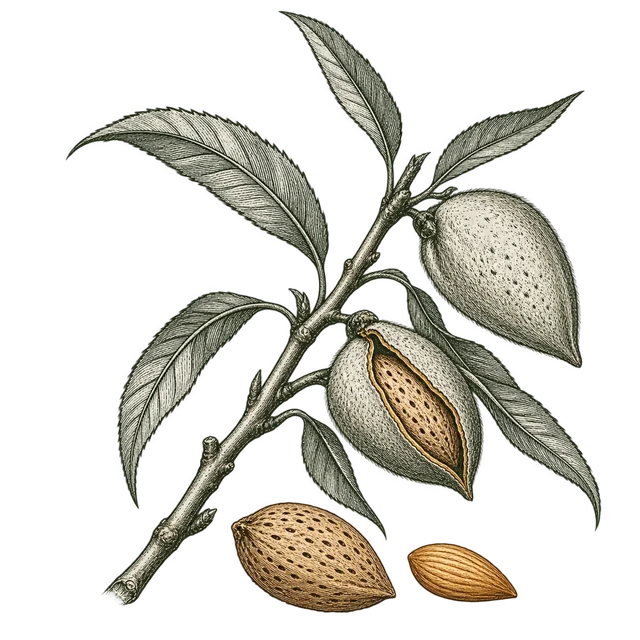
No single source plant. Dairy foods, eggs, almonds and mushrooms provide riboflavin; fortified cereals provide added vitamin. An isolated ingredient has no botanical family, and its manufacturing origin is product-specific.
Plant family / material: Not applicable: isolated vitamin, not a botanical.
Forms and route
Free riboflavin and riboflavin-5-phosphate occur in single-vitamin, B-complex and multivitamin supplements; foods contain free riboflavin and flavin coenzymes.
Food sources
USDA estimates: 1 cup 2% milk (244 g), 0.45 mg riboflavin; 1 oz dry-roasted unsalted almonds (28.35 g, about 22 kernels), 0.34 mg; 1 large hard-boiled egg (50 g), 0.26 mg. The milk record has added vitamins A and D; its riboflavin is naturally present.
Absorption and preparation
Riboflavin from food coenzymes and free riboflavin have similar bioavailability. Absorption becomes limited at larger single intakes, so a more concentrated product does not mean proportionally more uptake. Added meal fat or a special herb pairing is not required.
Nutritional role and uses
- Meeting normal nutrient requirements and correcting deficiency.
- Riboflavin is sometimes used as a migraine-prevention option after clinical review; this is separate from ordinary nutritional intake and acute-attack treatment.
- Its metabolic role does not establish extra energy, cancer prevention or general health benefits from high-dose supplementation when intake is adequate.
Contraindications and cautions
- Bright yellow urine after riboflavin supplementation is an expected color effect and by itself is generally harmless.
- No US UL is established because the available adverse-effect data do not define one; this does not make megadoses necessary or automatically safe.
- NIH ODS reports no known clinically relevant medication interactions for riboflavin itself. Combination-product ingredients need their own review.
- The 1998 migraine trial reported diarrhea and increased urination in two riboflavin recipients. Although neither event was serious, a small, short trial cannot settle long-term tolerability. Persistent symptoms deserve review of the dose, the full product and other possible causes.
Similar items and how they compare
- Vitamin B1 (thiamin)
Both are water-soluble B vitamins used to form coenzymes involved in releasing energy from carbohydrate and other nutrients.
Riboflavin supplies flavin coenzymes; thiamin supplies thiamin diphosphate for different enzyme reactions.
- Vitamin B6
Their pathways connect: riboflavin-derived FMN participates in conversion of vitamin B6 to its active pyridoxal-phosphate coenzyme form.
B6 coenzymes particularly support amino-acid reactions; riboflavin coenzymes also participate in oxidation–reduction reactions.
US adult reference amounts
US RDA for ages 19+: men 1.3 mg/day; women 1.1 mg/day; pregnancy 1.4 mg/day; lactation 1.6 mg/day. These describe total intake. There is no established US UL. Limited toxicity observations, including in short high-dose studies, are not evidence that unlimited long-term intake is safe.
Natural food portions
USDA estimates: 1 cup 2% milk (244 g), 0.45 mg riboflavin; 1 oz dry-roasted unsalted almonds (28.35 g, about 22 kernels), 0.34 mg; 1 large hard-boiled egg (50 g), 0.26 mg. The milk record has added vitamins A and D; its riboflavin is naturally present. Milk and an egg, or almonds within a varied meal, are practical food examples. Plant-milk riboflavin content depends on the actual product and fortification; it should not be assumed to match dairy milk.
Absorption, light and cooking
Riboflavin from food coenzymes and free riboflavin have similar bioavailability. Absorption becomes limited at larger single intakes, so a more concentrated product does not mean proportionally more uptake. Added meal fat or a special herb pairing is not required. Riboflavin is particularly light-sensitive, so keeping milk in light-protective packaging limits nutrient loss. It can also leach into water during cooking. Steaming or microwaving generally loses less into discarded water than boiling; there is no need to add fat to compensate.
Deficiency versus nonspecific symptoms
Deficiency is uncommon in the United States and often occurs alongside other nutrient shortfalls. Mouth-corner cracks, a sore tongue, skin changes or fatigue have many causes; symptoms alone do not diagnose B2 deficiency. People excluding dairy and other major sources can obtain riboflavin from appropriate plant foods and fortified products rather than assuming one food group is mandatory.
Migraine prevention evidence
A 1998 randomized trial in 55 people with migraine found fewer attacks and headache days over three months with high-dose riboflavin than with placebo. It was a small preventive study, not a test of stopping an attack already underway. NIH notes that some, but not all, small adult and pediatric studies have been positive; the evidence does not support extrapolating a self-treatment regimen to everyone.
Urine color and interactions
Riboflavin can make urine bright yellow or fluorescent; on its own, this expected pigment effect is generally harmless and is not evidence of detoxification. NIH ODS lists no known clinically relevant medication interactions for riboflavin itself. Check other ingredients in a combined supplement, particularly vitamins with established toxicity at excess intakes.
Food reference portions
- Milk, reduced fat, fluid, 2% milkfat, with added vitamin A and vitamin D
1 cup 2% milk (244 g): about 0.45 mg Riboflavin. Calculated from the named USDA record per 100 g and its food-specific household measure, or the stated weighed portion; rounded estimate. Data: SR Legacy; FDC 171267.
- Nuts, almonds, dry roasted, without salt added
1 oz dry-roasted unsalted almonds, about 22 kernels (28.35 g): about 0.34 mg Riboflavin. Calculated from the named USDA record per 100 g and its food-specific household measure, or the stated weighed portion; rounded estimate. Data: SR Legacy; FDC 170158.
- Egg, whole, cooked, hard-boiled
1 large hard-boiled egg (50 g): about 0.26 mg Riboflavin. Calculated from the named USDA record per 100 g and its food-specific household measure, or the stated weighed portion; rounded estimate. Data: SR Legacy; FDC 173424.
Evidence limits
- General adult nutrition reference; no user diagnosis or individualized supplement dose is inferred.
- RDA and AI values describe usual total daily intake, not additional supplement doses. A UL is a safety boundary, not a target; medical treatment requires its own supervised plan.
- Food amounts are rounded estimates for the specified edible food and preparation. Brands, fortification, storage, cooking and actual portion size can change composition.
Entry sources
- NIH Office of Dietary Supplements: Riboflavin (Health Professional Fact Sheet)
- NIH ODS: Thiamin
- NIH ODS: Vitamin B6
- USDA FoodData Central SR Legacy: nutrient data and household portions; FDC 171267, 170158, 173424
- Schoenen et al. Randomized trial of riboflavin for migraine prevention, 1998
Reference entry 42 · Recorded content review: 2026-10-05 · Review scope and dates