


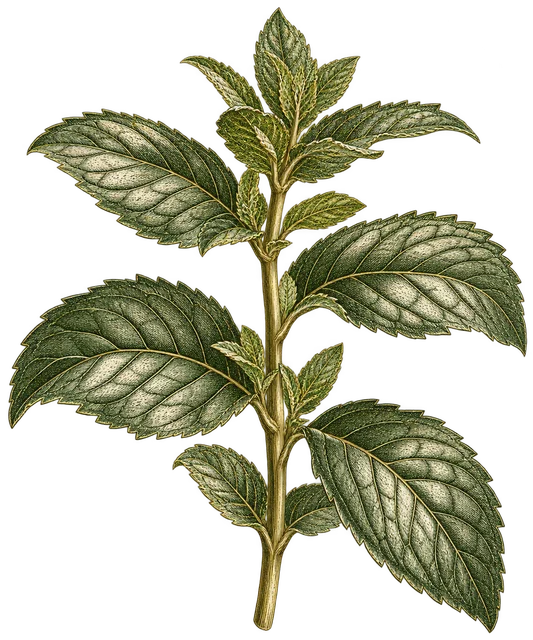
Key cautions
- Medicinal leaf products can worsen reflux. Avoid with peppermint/menthol allergy; get advice for gallstones or bile-duct/gallbladder disease.
- EMA does not recommend medicinal use during pregnancy/breastfeeding or under age 4. Worsening symptoms or symptoms lasting beyond two weeks need assessment.
What’s inside
Leaves contain aromatic oil (including menthol and menthone), flavonoids such as eriocitrin, and phenolic acids such as rosmarinic acid. Amounts vary with plant material and processing.
EMA: Peppermint leaf and oil assessment, historical-use sections
Uses in brief

- Traditional European use: relief of indigestion and gas with specified leaf preparations.
- Fresh leaves are culinary ingredients; tea evidence must be kept separate from peppermint-oil capsule studies.
- Hair-care form check: peppermint leaf and leaf rinses are distinct from concentrated peppermint essential oil.
Headache: evidence and form
Reviewed 2026-10-11. These notes support reference discovery, not diagnosis or an individualized treatment recommendation.
Context: Historical external leaf use; benefit unproven.
Evidence: Historical record, not clinical evidence of effectiveness.
Why it appears: Grieve’s 1931 herbal records bruised fresh peppermint leaves applied externally for headache. This documents past use, not clinical effectiveness.
Exact form: External fresh peppermint leaf in a historical account. This does not inherit essential-oil or capsule research and does not establish headache benefit from peppermint tea.
Caution: No established headache benefit for peppermint leaf. Historical recipes are not current treatment or safety guidance; peppermint or menthol allergy matters.
Sources: Maud Grieve: A Modern Herbal (1931), Mints, peppermint section · NCCIH: Peppermint oil and evidence boundaries
In the King James Bible
Related KJV name: mint
Uncertain botanical connection
Jesus names mint among the herbs carefully tithed in a teaching about judgment, mercy and faith. Mentha longifolia is a commonly proposed botanical identity; the verse does not specify the modern peppermint hybrid, Mentha × piperita.
Woe unto you, scribes and Pharisees, hypocrites! for ye pay tithe of mint and anise and cummin, and have omitted the weightier matters of the law, judgment, mercy, and faith: these ought ye to have done, and not to leave the other undone.
Matthew 23:23 (KJV)
Scripture and identification sources
Words & their stories
WORDS & THEIR STORIES
The name behind the KJV
Koine Greek · Matthew 23:23 (KJV)
ἡδύοσμονhēdýosmon
Mint, one of the herbs named in the discussion of tithes.
Dictionary form: ἡδύοσμον · hēdýosmon
Here the word is accusative neuter singular; it looks the same as its dictionary form. The Greek was checked in Scrivener’s 1894 Textus Receptus.
What the language reveals
Fragrance in the name
Thayer connects the name with Greek words for sweet and smell. That word formation describes fragrance, not a healing property.
A teaching about priorities
Mint belongs to the concrete illustration; the verse’s central concern is judgment, mercy and faith.
The Greek identifies mint without specifying peppermint, Mentha × piperita. Musselman proposes Mentha longifolia; the verse names no distilled essential oil.
History, folklore and reported uses
Indigestion and intestinal wind
European herbal handbooks record peppermint-leaf teas and extracts for indigestion, flatulence and intestinal discomfort. EMA preserves this longstanding leaf tradition, distinct from the concentrated oil used in other preparations.
EMA: Peppermint leaf and oil assessment, historical-use sections · EMA: Peppermint leaf, public assessment summary and current document index
Feverish colds
Grieve’s 1931 herbal describes peppermint-herb infusion as a perspiration-promoting household drink at the beginning of a cold. It also records combined peppermint-and-elderflower infusions in the British cold-remedy tradition.
Maud Grieve: A Modern Herbal (1931), Mints, peppermint section
Headache and local pain
Grieve records bruised fresh peppermint leaves applied externally for headache and local pain. This is a documented leaf application, rather than a historical claim borrowed from modern peppermint-oil products.
Maud Grieve: A Modern Herbal (1931), Mints, peppermint section
Nervous restlessness and sleep
Grieve describes compound peppermint-herb infusions for nervous complaints and sleeplessness. Other herbs were part of these preparations, so the record concerns a blended household remedy.
Maud Grieve: A Modern Herbal (1931), Mints, peppermint section
Nausea in modern natural medicine
In contemporary natural medicine, peppermint-leaf preparations are promoted for nausea and vomiting, including pregnancy-related sickness. NIH’s Office of Dietary Supplements records this leaf use alongside the separate use of peppermint oil.
NIH Office of Dietary Supplements: Pregnancy, peppermint leaf and oil promotion
Peppermint leaves in southern Italian cookery
A survey supported by preserved plant specimens at Cava de’ Tirreni, southern Italy, records Mentha × piperita leaves, locally called amenta, in a traditional calf- or pork-spleen dish. The preserved peppermint specimen is identified as Mattia 097.
Ethnobotanical research in Cava de’ Tirreni area, Southern Italy (2019), Table 1
The pyramid story and the English record
Jesse Millek and Lutz Popko trace the popular claim of peppermint in Egyptian pyramids through mistaken identifications and repeated translations. A firmer landmark is John Ray’s 1696 publication of the English pepper-mint following its identification in Hertfordshire. Cultivation around Mitcham later helped make it an international crop. Older Mediterranean mint traditions cannot automatically be assigned to this watermint–spearmint hybrid.
A leaf and a distilled oil
The cooling aromatic leaf travelled between food flavouring and household medicine, while distilled essential oil followed a separate path through pharmacy and flavouring. Both carry a recognizable scent, but concentrations and ways of use differ.
EMA: Peppermint leaf and oil assessment, historical-use sections
Women’s Health: traditions, evidence and cautions
Historical use does not establish benefit or safety. Pregnancy, breastfeeding and fertility care require particular caution: food, tea, essential oil and concentrated extract are not interchangeable. These records are not treatment, dosing or pregnancy-management instructions. Discuss supplements with a qualified clinician or pharmacist; do not delay evaluation of persistent symptoms.
Peppermint leaf
Mentha × piperita L.
- Plant part / material
- Leaf
- Preparation studied or reported
- Culinary leaf and leaf preparations; essential oil and formulated topical products are different materials.
LactMed notes both milk-suppression use and Turkish mint milk-increase beliefs. West Bank respondents reported postpartum cramp/settling uses.
Postpartum comfort and conflicting supply traditions
Human milk-supply effect unproven
Reported or traditional useTraditions conflict on milk supply; postpartum comfort uses also occur.
What the evidence supportsNo clinical trial establishes suppression of human milk supply; cell/animal menthol findings are not proof that peppermint leaf tea reduces milk.
Leaf, extracts and essential oil differ. Concentrates can cause digestive effects or allergy; medicinal pregnancy safety is unestablished.
- The cited lactation evidence does not establish medicinal-use safety during pregnancy; postpartum traditions must not be extrapolated to pregnancy.
Regional reading paths
These sourced notes describe cultivation, trade, food traditions or material history. A regional connection does not claim exclusive origin.
Europe
Cultivated and traditional processing/use: European mint-growing and leaf-tea traditions.
Dried leaf infusion and food flavouring; do not replace leaf with essential oil.
North America
Introduced/cultivated: United States, including Pacific Northwest.
Leaves flavor foods and infusions; distinct from concentrated oil.
Identity & detailed reference
Identity
Mentha × piperita L.; a Mentha aquatica × Mentha spicata hybrid. This entry concerns fresh/dried leaf and leaf preparations, not distilled oil.
Ingredient details, preparation and research
Also known as: Peppermint; Menthae piperitae folium
Source plant or material
Mentha × piperita L.; Fresh edible leaf or dried whole/cut leaf; leaf preparations are distinct from steam-distilled essential oil.
Plant family / material: Lamiaceae (mint family)
Forms and route
Fresh culinary leaves, dried-leaf infusion, and product-specific liquid or dry leaf extracts. EMA names 1:5 tinctures using 45% or 70% ethanol; other extracts need their own label. Distilled oil belongs to the separate oil card.
Vitamins and minerals
USDA’s reference portion of fresh edible peppermint leaf is 2 tablespoons (3.2 g): about 1 mg vitamin C, 7 micrograms vitamin A RAE and 8 mg calcium. This small food contribution must not be copied to dried leaf, strained tea or tincture.
Absorption and preparation
Hot-water extraction determines what reaches the cup; it is not the same as absorption in the body. Specific whole-leaf human absorption data are limited. Leaf tea and swallowed oil capsules both use the oral route; an enteric coating delays oil release until the capsule reaches the intestine.
Traditional and reported uses
- Traditional European use: relief of indigestion and gas with specified leaf preparations.
- Fresh leaves are culinary ingredients; tea evidence must be kept separate from peppermint-oil capsule studies.
- Hair-care form check: peppermint leaf and leaf rinses are distinct from concentrated peppermint essential oil.
Contraindications and cautions
- Medicinal peppermint leaf may worsen heartburn; EMA advises avoidance with gastroesophageal reflux.
- Gallstones or other bile-duct/gallbladder disease warrant clinical advice before medicinal leaf use.
- Do not use if allergic to peppermint or menthol.
- Medicinal use is not recommended during pregnancy or breastfeeding; ordinary food exposure does not establish extract safety.
- EMA does not recommend medicinal leaf use under 4. Its child/adolescent tea instructions differ from the adult reference; do not infer a child tincture dose.
- Seek assessment if digestive symptoms worsen or last beyond two weeks.
- No leaf interactions are reported in the EMA monograph. Check regular medicines and any alcohol-containing extract with a pharmacist.
Similar items and how they compare
- Peppermint essential oil
Same plant and overlapping aromatic constituents.
Distillation concentrates volatile compounds; leaf infusion also includes nonvolatile constituents.
- Spearmint leaf
Related culinary mint; a parent species of peppermint.
Mentha spicata is not Mentha × piperita; do not transfer peppermint evidence or dose by the common name mint.
Botanical identity and constituents
Mentha × piperita L., family Lamiaceae, is the hybrid of water mint and spearmint. A package labeled only “mint” may contain another species. Leaves contain aromatic oil, including menthol and menthone, plus flavonoids such as eriocitrin and phenolic acids such as rosmarinic acid; amounts vary with material and processing.
Traditional use, with its evidence boundary
EMA recognizes specified leaf preparations for traditional relief of indigestion and gas. NCCIH traces medicinal mint use to ancient Greece, Rome and Egypt; those accounts do not identify every ancient mint as today’s peppermint. Leaf-specific human research remains too limited to establish benefit for a particular condition. Oil-capsule findings are not tea results.
Preparation and measurement
USDA lists 2 tablespoons fresh edible leaves as 3.2 g; this is a food-composition measure. EMA’s adult infusion reference uses 1.5–3 g dried leaf in 100–150 mL boiling water. Follow the product label and individual advice; this is not a treatment schedule. No universal dried-leaf teaspoon weight was verified. Fresh-leaf spoon weights cannot be transferred to dried leaf.
Extracts are product-specific
EMA’s named leaf tinctures have a 1:5 ratio and 45% or 70% ethanol. Dry extracts and other liquid extracts require their own extraction ratio, solvent and label. Drops, millilitres and leaf grams are not interchangeable. No child tincture amount or generic extract dose can be inferred.
Nutrients and absorption
The fresh 3.2 g portion provides about 1 mg vitamin C, 7 micrograms vitamin A RAE and 8 mg calcium, a small contribution. These values do not describe a cup of strained tea or a tincture. Extraction into water and absorption into the body are different processes; specific whole-leaf pharmacokinetic data are limited. Both tea and swallowed oil capsules use the oral route.
Reflux, allergy and medicines
EMA advises avoiding medicinal leaf use with gastroesophageal reflux because heartburn may worsen. Avoid peppermint/menthol allergy; get advice with gallstones or other bile-duct/gallbladder disease. No leaf interactions are reported in the monograph, which is not proof of zero risk. Ask a pharmacist about regular medicines and alcohol-containing extracts.
Pregnancy, children and persistent symptoms
EMA does not recommend medicinal leaf use during pregnancy/breastfeeding or in children under 4. Child/adolescent tea instructions differ from the adult reference; ordinary food exposure does not establish concentrated-extract safety. Seek assessment if digestive symptoms worsen or last beyond two weeks. The EMA page listed a 2026 evidence call, with no newer adopted monograph identified at this review.
Related preparations
Peppermint essential oil comes from the same plant but concentrates volatile compounds and has different evidence and safety. Spearmint, Mentha spicata, is a related culinary mint and a parent species, not the same ingredient. Similarity does not establish dose equivalence or substitution.
Hair care: cosmetic role and evidence limits
Hair-growth research often cited for peppermint tested essential oil in mice, not peppermint leaves, tea or a leaf rinse. It does not establish human regrowth or a leaf-based treatment. Keep the separate essential-oil card and its route-specific cautions in view; do not replace clinical assessment of new shedding with a homemade mint preparation.
Evidence limits
- No universal household-spoon weight was verified for dried peppermint leaf; the fresh-leaf USDA measure cannot fill that gap.
- Dry extracts and tinctures beyond the named EMA preparations require a specific product label before dose, solvent exposure or equivalence can be assessed.
- The EMA page lists a 2026 periodic evidence call; no newer adopted monograph was listed on the review date.
- Clinical leaf efficacy and whole-preparation human absorption remain insufficiently characterized.
Entry sources
- EMA: Peppermint leaf, public assessment summary and current document index
- NCCIH: Peppermint Oil
- Kew: Mentha × piperita
- EMA: Peppermint leaf constituent assessment
- EMA: European Union herbal monograph on Mentha × piperita L., folium, revision 1
- EMA: Assessment report on Mentha × piperita L., folium and aetheroleum, revision 1
- NCI: Peppermint oil-containing enteric-coated microspheres
- USDA FoodData Central, SR Legacy: Peppermint, fresh (FDC 173474; official downloadable dataset)
- Kew Plants of the World Online: Mentha × piperita L.
- USDA National Nutrient Database for Standard Reference, Release 28: Peppermint, fresh, NDB 02064
- Ethnobotanical research in Cava de’ Tirreni area, Southern Italy (2019), Table 1
- Oh et al. (2014): Peppermint oil promotes hair growth in mice
Reference entry 13 · Recorded content review: 2026-10-05 · Review scope and dates