


Key cautions
- Avoid with Echinacea/daisy-family allergy; get a medication review with immunosuppressants, autoimmune disease or immune disorders.
- Pregnancy, breastfeeding and use in children need professional guidance. Check species, part and route; do not put an oral tincture on a wound.
What’s inside
Caffeic-acid derivatives, polysaccharides/glycoproteins and variable alkamides. E. purpurea commonly contains cichoric (chicoric) acid; E. angustifolia and E. pallida roots contain echinacoside. E. pallida root is relatively alkamide-poor and has characteristic ketones/polyacetylenes. No single constituent defines every Echinacea product.
EMA: Echinacea purpurea root assessment, revision 1 (2017) · EMA: Echinacea pallida root assessment, revision 1 (2018)
Uses in brief

- Traditional oral use: relief of common-cold symptoms; evidence for preventing or shortening colds varies by preparation.
- Separate traditional uses: selected root preparations for mild acne and fresh-herb topical products for small superficial wounds.
History, folklore and reported uses
Choctaw cough and digestive remedies
Between 1818 and 1848, Gideon Lincecum recorded Choctaw use of Echinacea purpurea root, chewed for cough and dyspepsia, or troubled digestion. He later described a root tincture for the same complaints. Twentieth-century German practice developed a different respiratory medicine from expressed flowering-herb juice.
Williams, Jenks and Brinckmann: Echinacea purpurea, HerbalGram 138 (2023), standalone profile
Toothache and sore gums
USDA’s ethnobotanical guide records Echinacea angustifolia root used for toothache by Dakota, Omaha, Pawnee, Ponca, Teton Sioux and Winnebago communities. The root also had a wider pain-relieving reputation in Plains medicinal practice.
USDA NRCS: Purple Coneflower, Echinacea angustifolia, Plant Guide
External wound care
The 1989 monograph from Commission E, Germany’s herbal-medicine assessment panel, included topical fresh-pressed E. purpurea flowering-herb juice for poorly healing wounds and chronic ulcerations. Later European traditional-use monographs narrowed the household indication to small superficial wounds.
Williams, Jenks and Brinckmann: Echinacea purpurea, HerbalGram 138 (2023), standalone profile
Lower urinary-tract support
The 1989 German Commission E account listed oral E. purpurea flowering-herb juice as supportive therapy for chronic lower urinary-tract infections. The preparation was pressed juice from the fresh flowering aerial parts, used within twentieth-century German herbal medicine.
Williams, Jenks and Brinckmann: Echinacea purpurea, HerbalGram 138 (2023), standalone profile
Several plants, several histories
The most extensively recorded Plains medicinal traditions concern E. angustifolia; these cannot simply be transferred to the garden coneflower E. purpurea. The American Botanical Council’s 2023 history highlights this imbalance rather than treating Indigenous medicine as one universal tradition.
American Botanical Council, HerbalGram 138: Echinacea purpurea herb profile · Williams, Jenks and Brinckmann: Echinacea purpurea, HerbalGram 138 (2023), standalone profile
From patent medicine to the formulary
H. C. F. Meyer promoted an echinacea preparation in the 1870s. Identification and advocacy by the Lloyd pharmacists and physician John King helped E. angustifolia gain a place in the American Eclectic school of medicine, which emphasized plant remedies. In 1916, it entered the United States National Formulary, a pharmaceutical reference. Later European cultivation and commercial products shifted public attention toward colds and immune support.
American Botanical Council, HerbalGram 138: Echinacea purpurea herb profile · Williams, Jenks and Brinckmann: Echinacea purpurea, HerbalGram 138 (2023), standalone profile
Regional reading paths
These sourced notes describe cultivation, trade, food traditions or material history. A regional connection does not claim exclusive origin.
North America
Native: United States east of the Rocky Mountains.
Herbal supplements; preparation-specific evidence and allergy cautions matter.
Identity & detailed reference
Identity
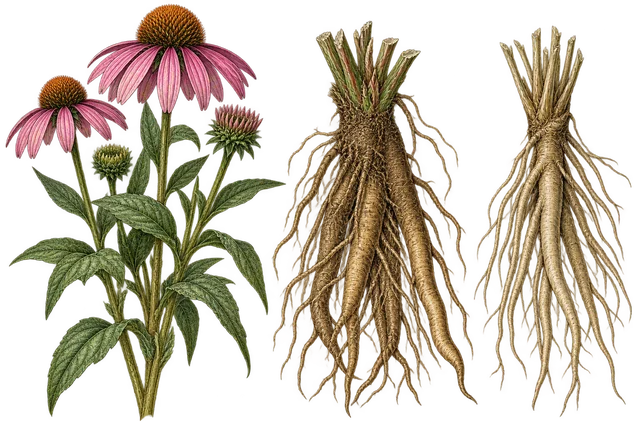
Echinacea purpurea (L.) Moench, E. angustifolia DC. or E. pallida (Nutt.) Nutt.; species-specific roots and/or above-ground herb, in Asteraceae. They are related medicinal materials, not interchangeable extracts.
Ingredient details, preparation and research
Source plant or material
Echinacea purpurea fresh flowering aerial parts or root; E. angustifolia root; E. pallida root. Identify species and part on the product.
Plant family / material: Asteraceae (daisy family; also called Compositae).
Forms and route
Oral dried herb/root, tea, powder, expressed fresh-herb juice, dry extracts, liquid extracts and alcohol tinctures; separately formulated topical products. Match species, plant part, extraction method, strength and intended route before comparing preparations.
Vitamins and minerals
A usual cup of Echinacea tea or a small tincture/extract serving has no dependable vitamin/mineral contribution established here. Vitamin C or zinc in a combination product should be counted from its label, not attributed automatically to Echinacea.
Absorption and preparation
A three-person crossover study detected rapidly absorbed alkamides from specific E. purpurea/E. angustifolia root liquid and tablet extracts, with no significant difference in overall exposure. This very small study does not show that all liquids outperform tablets or that tea reproduces either product. A marker entering blood is not proof of a clinical benefit.
Practical preparation
Choose a labeled, correctly identified product and follow its preparation instructions. Tea, pressed fresh-herb juice and ethanol-root extracts have different mixtures; millilitres of one are not equivalent to millilitres of another. Check whether a liquid contains alcohol. Use only a skin-labeled finished product by the topical route.
Combination notes
Cold-season blends may combine Echinacea with elderberry, vitamins or minerals. A trial of a blend cannot isolate the contribution of Echinacea, and combining separate products does not establish synergy. Count added nutrients across labels.
Traditional and reported uses
- Indigenous North American medicinal histories include respiratory complaints and tooth pain. Practices differed among peoples and species; modern commercial extracts do not represent one universal tradition.
- Documented European herbal use includes relief of common-cold symptoms, with distinct assessments for roots and fresh E. purpurea herb.
- Particular E. purpurea root preparations have a traditional mild-acne indication; specific fresh-herb skin preparations have traditional use for small superficial wounds.
- Human cold research is mixed. Some preparations may modestly reduce the chance of a cold, but a reliable shortening of illness is not established across products.
Contraindications and cautions
- Avoid with known Echinacea or Asteraceae allergy; severe allergic reactions are possible. Abdominal pain and nausea can occur. People with asthma or strong allergic tendencies need particular caution.
- EMA advises against relevant medicinal preparations in progressive systemic disorders, autoimmune disease, immunodeficiency, immunosuppression or white-blood-cell disorders. This is precautionary guidance, not proof that every preparation worsens these conditions.
- Review immunosuppressants and other medicines with a clinician or pharmacist. Immunosuppressant interaction is theoretically plausible; liver-enzyme interaction evidence is conflicting and preparation-dependent.
- Pregnancy and breastfeeding safety is inadequately established. EMA medicinal guidance does not recommend use under 12; children should not be given an adult product without professional advice.
- Follow the product’s short-term directions. Persistent fever, breathing difficulty or worsening respiratory symptoms need assessment. Oral tinctures and homemade plant material are not substitutes for appropriate wound care.
Similar items and how they compare
- Elderberry
Both occur in contemporary cold-season products and have respiratory-use traditions.
Elderberry fruit requires appropriate processing; Echinacea comparisons hinge on species, root versus aerial herb and extraction.
- Garlic
Both have historical respiratory uses and chemically variable oral supplements.
Garlic is a culinary bulb with sulfur chemistry and bleeding precautions; Echinacea has distinct allergy and immunosuppression cautions.
Identity, species and plant parts
The three principal medicinal names are E. purpurea, E. angustifolia and E. pallida. E. purpurea supplies both root and flowering aerial herb; the other two are chiefly represented by root preparations in EMA assessments. A garden plant labeled only “coneflower” does not establish the identity of a studied medicinal preparation.
Constituents are preparation-dependent
Caffeic-acid derivatives, alkamides and larger polysaccharides/glycoproteins occur in different proportions. Cichoric acid is prominent in E. purpurea, whereas echinacoside is important in E. angustifolia and E. pallida roots. Pallida root has very little alkamide and a different ketone/polyacetylene fraction. Water, ethanol and expressed juice select different mixtures; standardizing one marker does not make all products equivalent.
Traditional knowledge and separate uses
NCCIH records Indigenous North American respiratory and dental uses, while Kew notes the importance of E. angustifolia in Great Plains medicinal histories. These histories deserve attribution without treating all Indigenous practice as identical. EMA separately recognizes traditional cold-symptom use of root preparations and a mild-acne use for a specified E. purpurea root extract; this is not clinical proof of an acne cure.
Human common-cold findings
In a 2005 experimental rhinovirus trial, 437 volunteers were randomized and 399 participants exposed to the cold virus were analyzed; three chemically distinct E. angustifolia root extracts showed no significant prevention or symptom benefit. A separate 719-person natural-cold trial found no statistically significant improvement in duration or severity from the tested root tablets. NCCIH nevertheless concludes that the wider evidence permits a possible small reduction in cold occurrence, while shortening remains unclear.
Fresh-herb and skin evidence are distinct
EMA gives certain expressed-juice preparations of fresh E. purpurea aerial herb a well-established-use assessment for short-term common-cold prevention/treatment, and recognizes traditional topical use for superficial wounds. That narrower European product assessment is not a claim that every tea, species or supplement works. Cell-level immune or antimicrobial effects also do not establish an infection cure in people.
Absorption and nutrition
The liquid-versus-tablet pharmacokinetic comparison involved only three people and matched particular ethanolic root extracts. Both delivered measurable alkamides; it was not a test of tea or clinical outcomes. No reviewed evidence supports an added-fat, fasting or herb-combination rule to improve ordinary use. Nutrient claims for combination products need their own declared vitamin/mineral amounts.
Practical preparation and route
Use the labeled species, part and extraction strength to identify what is actually being taken. Follow a tea product’s water and infusion directions rather than converting a trial extract into kitchen spoonfuls. Alcohol content and intended route matter. A product intended to be swallowed should not be improvised into a wound rinse or acne application.
Safety and interactions
Hypersensitivity can be serious, particularly with relevant plant allergy. EMA’s immune-disorder cautions and the theoretical immunosuppressant interaction warrant individual review; they do not quantify harm for every formulation. Evidence about drug-metabolizing enzymes is inconsistent. Lack of adequate pregnancy, lactation and pediatric data argues against treating a familiar herb as automatically safe in those settings.
Related products and interpretation
Elderberry and garlic share cold-season traditions but are not chemical substitutes. Multi-ingredient formulations need separate evaluation; any observed benefit belongs to the formulation studied. Neither an absorbed marker nor a laboratory immune response justifies an “immune-boosting” guarantee.
Entry sources
- NCCIH: Echinacea, usefulness and safety (updated November 2024)
- EMA: Purple coneflower root, traditional-use conclusions
- EMA: Purple coneflower fresh herb, oral and topical preparations
- Kew: Echinacea purpurea, accepted name and Asteraceae family
- EMA: Echinacea purpurea root assessment, revision 1 (2017)
- EMA: Echinacea pallida root assessment, revision 1 (2018)
- EMA: Echinacea angustifolia root monograph (2012)
- Turner et al. (2005): Echinacea angustifolia root extracts in experimental rhinovirus infection
- Barrett et al. (2010): Randomized trial of Echinacea for treating the common cold
- Matthias et al. (2007): Human comparison of Echinacea alkylamides from liquid and tablets
- NIH ODS: Dietary Supplements for Immune Function and Infectious Diseases
- FDA: Daily Value on the Nutrition and Supplement Facts labels
Reference entry 03 · Recorded content review: 2026-10-05 · Review scope and dates