


Key cautions
- Avoid medicinal use in pregnancy; check liver health, allergies and medicines.
- Dengue warning signs or postpartum bleeding need urgent care.
What’s inside
Leaf studies identify carpaine and several flavonoids, including rutin. The amount delivered depends on the material and preparation; chemistry alone does not demonstrate treatment effectiveness.
Uses in brief

- Explore documented leaf traditions and preparation-specific evidence.
- Human platelet-count research, with important limits.
History, folklore and reported uses
History, folklore and traditional uses
A Ugandan survey records papaya leaf decoction for postpartum-bleeding care. The table lists one report and month 9 as timing; it does not establish that the preparation was taken after delivery. In northern Angola, papaya leaves appear in a local belief about cleaning breastmilk, rather than an established biomedical diagnosis.
Indonesian lactation traditions and Malaysian dengue research broaden the leaf record beyond reproductive-history indexing. These accounts should remain attached to their place, purpose and preparation.
Traditional, historical and reported uses
- Reproductive folk history
Traditional accountWhy this label?
The source is retained with its design and preparation limits; reported use is not upgraded to clinical effectiveness.
A Ugandan survey records leaf decoction for postpartum-bleeding care; an Angolan survey records a local milk-quality belief. The Ugandan root preparation listed for uterine contractions is a separate plant-part record. These reports document use, not demonstrated treatment efficacy.
- Separate platelet-count research
Human researchWhy this label?
The source is retained with its design and preparation limits; reported use is not upgraded to clinical effectiveness.
A randomized dengue study tested manufactured leaf-extract tablets alongside standard care. A platelet-count result is not proof that leaves stop postpartum bleeding.
Includes only uses and context documented for this material. Historical reporting is not proof of benefit; no use-count quota is applied.
Story sources
- 2024 Najjembe maternal ethnomedicine survey
- Jendras et al. 2020: BaKongo plants, food and breastmilk traditions
- Kasture et al. 2016: Papaya leaf extract in dengue-associated thrombocytopenia
- LactMed: Papaya, revised January 2025
- Subenthiran et al. 2013: Papaya leaf juice in dengue
- Uganda maternal ethnomedicine survey 2024: Table 2, papaya row
Women’s Health: traditions, evidence and cautions
Historical use does not establish benefit or safety. Pregnancy, breastfeeding and fertility care require particular caution: food, tea, essential oil and concentrated extract are not interchangeable. These records are not treatment, dosing or pregnancy-management instructions. Discuss supplements with a qualified clinician or pharmacist; do not delay evaluation of persistent symptoms.
Papaya leaf: medicinal history and evidence
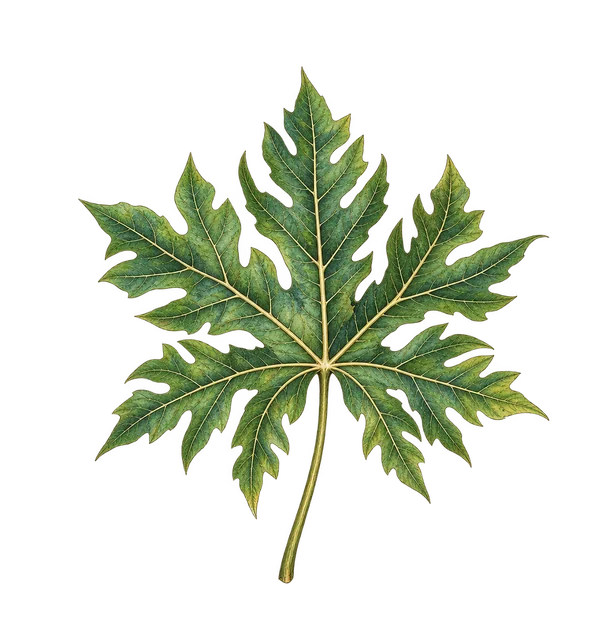
Carica papaya L.
- Plant part / material
- Leaves
- Preparation studied or reported
- Traditional medicinal leaf preparations and study-specific manufactured leaf extracts, kept distinct. No recipe, labour-induction or breastmilk-cleansing directions are supplied.
Papaya leaves belong to Carica papaya. The Ugandan and Angolan records concern leaves, whereas the Vanuatu postpartum food record concerns fruit; neither can authenticate a commercial leaf supplement.
The Ugandan record includes leaves in postpartum-bleeding care. In northern Angola, leaves belong to a local belief about cleaning breastmilk; the concept is not an established biomedical diagnosis.
Reproductive folk history
Traditional account
Reported or traditional useLeaf use was reported in Ugandan postpartum care and an Angolan milk-quality belief. These accounts do not establish haemorrhage treatment or breastmilk detoxification.
What the evidence supportsDisease, product and outcome matter. A dengue trial in clinical care does not test home leaf remedies, pregnancy safety or breastmilk transfer. LactMed finds milk-supply evidence inadequate. MSK notes potential interactions in preclinical work, including glucose-lowering medicines and some antibiotics; clinical relevance remains uncertain. These uncertainties should stay visible rather than become a blanket safety claim.
Avoid medicinal papaya leaf use in pregnancy; seek clinician review with liver disease. Breastfeeding safety and infant exposure are not established. Do not use leaves to cleanse milk. Digestive upset and rash are reported. Review medicines, particularly glucose-lowering treatment, with a clinician. Postpartum bleeding requires urgent care; a platelet study is not a substitute for haemorrhage treatment.
Separate platelet-count research
Human research
Reported or traditional useA randomized dengue study tested manufactured leaf-extract tablets alongside standard care. A platelet-count result is not proof that leaves stop postpartum bleeding.
What the evidence supportsDisease, product and outcome matter. A dengue trial in clinical care does not test home leaf remedies, pregnancy safety or breastmilk transfer. LactMed finds milk-supply evidence inadequate. MSK notes potential interactions in preclinical work, including glucose-lowering medicines and some antibiotics; clinical relevance remains uncertain. These uncertainties should stay visible rather than become a blanket safety claim.
Avoid medicinal papaya leaf use in pregnancy; seek clinician review with liver disease. Breastfeeding safety and infant exposure are not established. Do not use leaves to cleanse milk. Digestive upset and rash are reported. Review medicines, particularly glucose-lowering treatment, with a clinician. Postpartum bleeding requires urgent care; a platelet study is not a substitute for haemorrhage treatment.
Composite source must not be copied wholesale. Use this record’s explicit material_profile only; other papaya parts and routes are excluded.
- Avoid medicinal papaya leaf use in pregnancy; seek clinician review with liver disease.
- Breastfeeding safety and infant exposure are not established. Do not use leaves to cleanse milk.
- Digestive upset and rash are reported. Review medicines, particularly glucose-lowering treatment, with a clinician.
- Postpartum bleeding requires urgent care; a platelet study is not a substitute for haemorrhage treatment.
- 2024 Najjembe maternal ethnomedicine survey
- Jendras et al. 2020: BaKongo plants, food and breastmilk traditions
- Kasture et al. 2016: Papaya leaf extract in dengue-associated thrombocytopenia
- LactMed: Papaya, January 2025
- Memorial Sloan Kettering: Papaya leaf
- Kew Plants of the World Online: Carica papaya
Read the complete historical reference and its material distinctions
Identity & detailed reference
Identity
Leaves of Carica papaya L., kept separate from ripe fruit, seeds, root, crude latex and isolated papain. Leaf juice, leaf tea, cooked leaf foods and standardized extracts can differ substantially in composition and concentration. A preparation must be identified before evidence or safety can be transferred.
Ingredient details, preparation and research
Also known as: papaya leaf; papaya leaves; Carica papaya leaf; daun pepaya
Source plant or material
Carica papaya L.; leaf.
Plant family / material: Caricaceae
Forms and route
Fresh leaf juice, dried-leaf infusions and manufactured oral extracts appear in traditional use or research. The clinical preparations described here are not a home recipe or a standardized dose for every product.
Vitamins and minerals
No fruit nutrient values or therapeutic nutrient claims are assigned to leaf preparations. A cooked leaf food, infusion and extract are not nutritionally equivalent.
Absorption and preparation
There is no verified household method here for improving absorption or standardizing exposure. Concentration and extraction can change which compounds are delivered.
Practical preparation
This reference does not provide a medicinal leaf recipe. Record species, plant part, extraction method and product composition before comparing a preparation with clinical research.
Traditional and reported uses
- Traditional use: a Ugandan survey records leaf decoction for postpartum-bleeding care; Angolan and Indonesian sources describe distinct milk-quality and lactation practices.
- Human research: leaf juice and manufactured extracts have been investigated alongside clinical care for dengue-associated low platelet counts.
Contraindications and cautions
- Avoid medicinal leaf preparations in pregnancy. With liver impairment, seek clinical advice before use; concerns include animal findings and limited human safety evidence.
- Stomach upset and rash have been reported. Ask a pharmacist to review medicines, particularly glucose-lowering drugs; proposed interactions are mainly preclinical and their clinical importance is uncertain.
- Breastfeeding safety and transfer into milk are not adequately established. Do not use leaf remedies to cleanse milk or replace feeding assessment.
- Suspected dengue needs prompt medical assessment. Seek urgent care for belly pain, repeated vomiting, bleeding, marked tiredness or restlessness, especially when fever settles. A platelet rise does not rule out deterioration.
- Postpartum bleeding needs urgent care. Dengue platelet research does not establish treatment for obstetric haemorrhage.
Similar items and how they compare
- Papaya flesh (entry 417)
Same species.
Fruit food safety and nutrient findings do not establish leaf-extract safety.
- Papaya seed (entry 194)
Same species.
A separate plant part with separate evidence.
- Papaya latex (entry 566)
A related plant material.
Crude latex experiments are not direct tests of leaf tea or juice.
Tradition and lactation are separate evidence questions
The Angolan survey records papaya leaves in a local milk-quality tradition. LactMed describes a small papaya-only leaf-extract study that found increased serum prolactin, a hormone involved in lactation. A prolactin change alone does not establish increased milk intake or improved infant growth. Separate mixed-herb studies reported positive or null findings; those mixtures cannot isolate papaya’s contribution. Reliable papaya-specific clinical benefit and milk-transfer safety remain unsettled. This uncertainty does not erase the history of use.
Dengue: a promising outcome with important qualifications
The 2013 Malaysian open-label trial added fresh leaf juice to standard care. Of 290 recruited patients, 228 were analyzed. Later platelet counts favoured juice, but the overall treatment comparison across time was not significant. Missing data and lack of blinding limit confidence. Pregnant or breastfeeding patients, severe dengue haemorrhagic fever, substantial liver-test abnormalities and specified comorbidities were excluded, limiting safety extrapolation. Platelet recovery is not proof of preventing shock, major bleeding or death. Manufactured-extract trials concern their own formulations rather than any home tea.
Preparation-specific safety
Short clinical exposures cannot establish the safety of prolonged or concentrated use. Pregnancy and liver-health cautions should remain visible. Evidence about the ripe fruit or crude latex should not be automatically assigned to leaf preparations, and a traditional method should be described accurately before its risks are judged.
When medical assessment cannot wait
Dengue can worsen rapidly, including after the fever has resolved. Abdominal pain, repeated vomiting, bleeding or pronounced tiredness/restlessness warrant urgent care. A blood count or herbal remedy cannot replace assessment of the whole patient.
Evidence limits
- Draft update retaining the existing stable ID and slug; independent editorial and clinical-source review remains required.
- No home treatment regimen, pregnancy or lactation recommendation, cancer cure or dengue cure is supplied.
Entry sources
- 2024 Najjembe maternal ethnomedicine survey
- Jendras et al. 2020: BaKongo plants, food and breastmilk traditions
- Kasture et al. 2016: Papaya leaf extract in dengue-associated thrombocytopenia
- LactMed: Papaya, January 2025
- Memorial Sloan Kettering: Papaya leaf
- Kew Plants of the World Online: Carica papaya
- Kew: Carica papaya, accepted identity and distribution
- Subenthiran et al. 2013: Papaya leaf juice in dengue
- LactMed: Papaya, revised January 2025
- CDC: Dengue symptoms and emergency warning signs
- Uganda maternal ethnomedicine survey 2024: Table 2, papaya row
Reference entry 567 · Content review date not recorded · Review scope and dates