


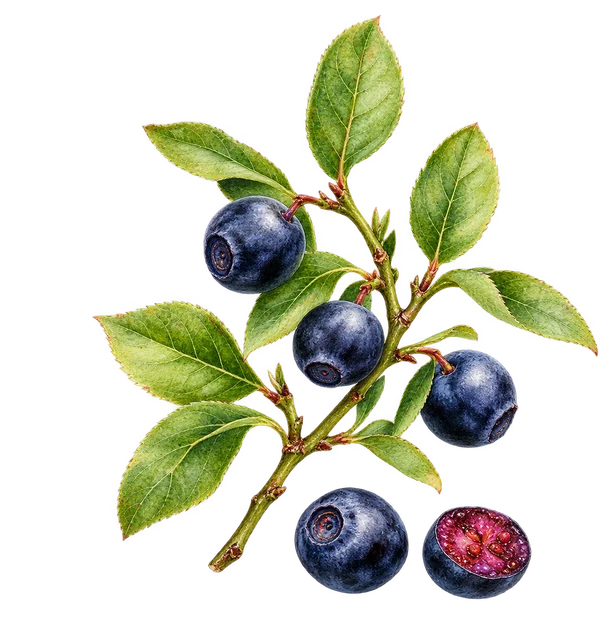
Key cautions
- Use reliably identified food-grade berries; this illustration or common name is not a foraging guide.
- Follow fresh-produce handling and frozen-product directions. Do not use fruit-supplement claims as permission to consume bilberry leaves or concentrated extracts.
What’s inside
Water, fibre, natural sugars, organic acids and anthocyanin pigments concentrated in the deeply coloured fruit. Composition changes with ripeness, processing and whether skins are retained.
Uses in brief

- Berry soups and porridge
- Baking and preserves
History, folklore and reported uses
History, folklore and traditional uses
Native/wild-collected: Finnish forests and northern European traditions.
Traditional, historical and reported uses
- Berry soups and porridge
Food or household practiceWhy this label?
The linked sources document this material-specific use; no treatment outcome or universal safety is inferred.
The Finnish Arctic Flavours Association records bilberries in berry soups and porridge. These preparations use the fruit as a flavour and texture ingredient, not an extract.
- Baking and preserves
Food or household practiceWhy this label?
The linked sources document this material-specific use; no treatment outcome or universal safety is inferred.
Bilberries are documented in baked foods, juice and jam. Straining, sweetening and heating produce different foods, so a whole-fruit nutrient description should not be copied unchanged.
2 supported material-specific uses; practices are not proof of treatment efficacy.
Historical-use additions reviewed 2026-10-09
Regional reading paths
These sourced notes describe cultivation, trade, food traditions or material history. A regional connection does not claim exclusive origin.
Europe
Native/wild-collected: Finnish forests and northern European traditions.
Berries eaten as food and made into preserves or baked dishes.
Identity & detailed reference
Identity
Bilberry is the dark fruit of Vaccinium myrtillus. It is distinct from the highbush, lowbush and rabbiteye crop groups commonly sold as blueberries, despite overlapping everyday names.
Ingredient details, preparation and research
Also known as: European bilberry; Blaeberry; Vaccinium myrtillus
Source plant or material
Vaccinium myrtillus L.
Plant family / material: Ericaceae
Forms and route
Fresh or frozen whole fruit, dried berries, cooked berry foods and preserves. Leaf preparations and standardised anthocyanin extracts are outside this ordinary-food profile.
Vitamins and minerals
Whole berries provide fibre that strained juice may lose. Jam includes added sugar, while drying removes water and changes the amount represented by a spoonful.
Absorption and preparation
Anthocyanins are metabolised after eating; pigment intensity cannot predict a treatment effect. No special pairing is required for culinary use.
Practical preparation
Refrigerate fresh berries and discard mouldy fruit. Rinse as appropriate before use, follow cooking directions on frozen products, and use tested preservation instructions for storage beyond refrigeration or freezing.
Combination notes
Use in ordinary berry recipes; retain the distinction between unsweetened fruit and sweetened preserves.
Traditional and reported uses
- Berry soups and porridge
- Baking and preserves
Contraindications and cautions
- Use reliably identified food-grade berries; this illustration or common name is not a foraging guide.
- Follow fresh-produce handling and frozen-product directions. Do not use fruit-supplement claims as permission to consume bilberry leaves or concentrated extracts.
Similar items and how they compare
- Blueberries
Both are Vaccinium fruits.
Vaccinium myrtillus is not a generic cultivated blueberry.
Bilberry versus cultivated blueberry
The Finnish species account distinguishes Vaccinium myrtillus from cultivated blueberry types, including its dark interior. Similar colours and names do not establish the same botanical food.
Eye-health claims need restraint
NCCIH reports that rigorous studies have not established improved night vision in healthy people. A story about bilberry jam or laboratory antioxidant activity is not proof of a treatment.
Evidence limits
Food history and composition are not evidence of treating eye disease or diabetes. Extract and leaf safety cannot be inferred from ordinary berry consumption.
Entry sources
- Arctic Flavours Association: Bilberry
- NCCIH: Bilberry, usefulness and safety
- FDA: Selecting and serving produce safely
Reference entry 380 · Recorded content review: 2026-10-09 · Review scope and dates