


Key cautions
- Do not apply neat oil or improvise an oral dose. Keep concentrated bottles away from children.
- Expressed bergamot can cause phototoxic reactions on light-exposed skin. Use a professionally formulated product according to its label; do not assume that dilution alone removes this hazard.
What’s inside
Limonene, linalyl acetate and linalool are important volatile constituents. Expressed oil can also contain phototoxic furocoumarins, including bergapten.
Uses in brief

- Perfumery and cologne
- Specified aromatic formulations
History, folklore and reported uses
History, folklore and traditional uses
Cultivated and traditional processing: Reggio Calabria, Italy.
Traditional, historical and reported uses
- Perfumery and cologne
Food or household practiceWhy this label?
The linked sources document this material-specific use; no treatment outcome or universal safety is inferred.
Italy’s tourism authority documents Reggio Calabria’s extraction history and perfume tradition. The oil contributes a citrus aroma in finished compositions rather than being a stand-alone skin treatment.
- Specified aromatic formulations
Food or household practiceWhy this label?
The linked sources document this material-specific use; no treatment outcome or universal safety is inferred.
EMA distinguishes different bergamot preparations and reviews their history and limitations. Such uses concern controlled ingredient specifications, not substituting arbitrary peel oil in food or medicine.
2 supported material-specific uses; practices are not proof of treatment efficacy.
Historical-use additions reviewed 2026-10-09
Regional reading paths
These sourced notes describe cultivation, trade, food traditions or material history. A regional connection does not claim exclusive origin.
Europe
Cultivated and traditional processing: Reggio Calabria, Italy.
Citrus peel oil important in perfumery; expressed grades can be phototoxic, so use professionally formulated products.
Identity & detailed reference
Identity
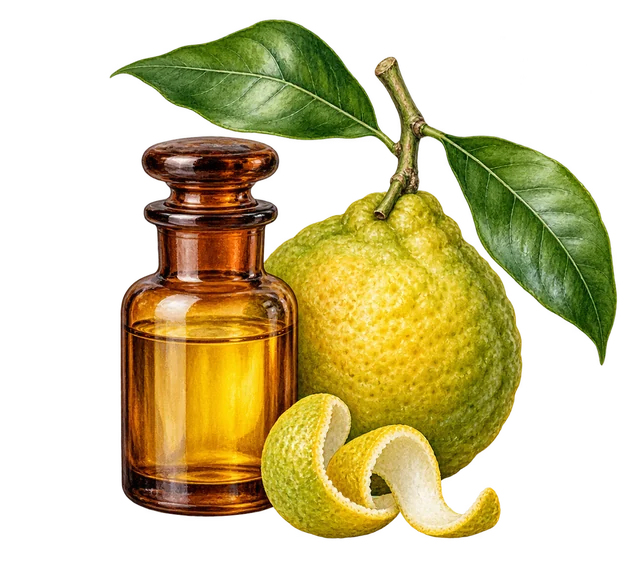
Bergamot essential oil is an aromatic concentrate obtained from Citrus bergamia peel, usually by expression. It is not the American herb called bee balm or bergamot, Monarda.
Ingredient details, preparation and research
Also known as: Calabrian bergamot oil; Citrus bergamia peel oil
Source plant or material
Citrus × bergamia Risso & Poit.
Plant family / material: Rutaceae
Forms and route
Expressed peel oil, specified processed fractions and professionally formulated fragrance products. Furocoumarin-reduced grades differ from untreated expressed oil.
Vitamins and minerals
Essential oil is not a source of fruit fibre, vitamin C or an ordinary dietary serving. Nutrient comparisons with citrus fruit are inappropriate.
Absorption and preparation
Skin penetration is not evidence of a benefit. Sunlight can interact with phototoxic constituents; a carrier oil does not by itself establish a safe formulation.
Practical preparation
Identify the exact grade and intended use. Choose a finished fragrance or cosmetic with directions rather than attempting a home skin formula; store closed and protected from light.
Combination notes
Use only within an appropriately labelled finished product; blending it with another essential oil does not neutralise phototoxicity.
Traditional and reported uses
- Perfumery and cologne
- Specified aromatic formulations
Contraindications and cautions
- Do not apply neat oil or improvise an oral dose. Keep concentrated bottles away from children.
- Expressed bergamot can cause phototoxic reactions on light-exposed skin. Use a professionally formulated product according to its label; do not assume that dilution alone removes this hazard.
- Fragrance allergy or irritation remains possible even for furocoumarin-reduced products.
Similar items and how they compare
- Lemon essential oil
Both are citrus peel aromatics.
Chemical composition and phototoxicity cannot be assumed identical.
Human phototoxicity research
Laboratory testing combined with human patch tests examined bergamot oil’s light-related skin effects. This supports a real safety concern, not a recipe for finding a personal safe concentration.
No adopted herbal monograph implied
The EMA assessment does not justify presenting bergamot as a proven treatment or assuming that every commercial grade has equivalent safety. Processing can alter the furocoumarin fraction.
Evidence limits
This is an aromatic-material reference. No ingestible formulation, skin dilution percentage or therapeutic effect is supplied.
Entry sources
- Italia.it: Calabrian bergamot, from table to perfume
- EMA: Assessment report on Citrus bergamia essential oil, including phototoxicity
- Kejlová et al.: Bergamot phototoxicity, laboratory and human patch-test study
Reference entry 373 · Recorded content review: 2026-10-09 · Review scope and dates