


Key cautions
- Pregnancy: avoid medicinal preparations; ask about cooked fruit.
- Insulin or glucose-lowering medicines: check before medicinal use or major intake changes.
- Discard seeds; food and extracts are not interchangeable.
What’s inside
Water, fiber, vitamin C, folate and potassium. Composition changes with preparation; seed constituents are not a reason to eat the seeds.
Uses in brief

- Stir-fries and spiced vegetable dishes
- Soups and stuffed fruit
- Documented traditional-use history
History, folklore and reported uses
History, folklore and traditional uses
Bitter melon is a climbing member of the gourd family. Kew records a broad native range across the tropical and subtropical Old World into the South Pacific; its food story spans more than one country.
Food traditions and medicinal traditions also use different plant parts. An account of a historical remedy records what people did, without proving that it worked or that it is safe to reproduce.
Traditional, historical and reported uses
- Stir-fries and spiced vegetable dishes
Food or household practiceWhy this label?
The claim describes documented cooking methods, not efficacy.
UF/IFAS describes Chinese preparations with garlic, egg, pork or fermented black soybeans, and Indian preparations using salt, tamarind and spices before pan-frying. These are examples, not a single universal recipe.
- Soup ingredient
Food or household practiceWhy this label?
The claim describes a culinary use.
Singapore’s National Parks Board records immature bitter melon as an ingredient in soups. This use treats the fruit as part of a cooked meal.
- Stuffed vegetable
Food or household practiceWhy this label?
The claim describes a culinary preparation.
Hollowed fruit can hold a savory filling; NParks specifically documents minced-pork stuffing. Cook the filling safely as well as the surrounding vegetable.
- Reported traditional use for diabetes
Traditional accountWhy this label?
The source explicitly summarizes reported traditional use for diabetes; this claim does not assert clinical efficacy.
Beloin and colleagues summarize reports of bitter-melon fruit used for diabetes in Asian traditional medicine. This documents an intended use, not proof that a meal or extract controls diabetes. It does not justify replacing or changing prescribed treatment.
- Reported medicinal traditions in Togo
Traditional accountWhy this label?
Primary field interviews document reported practices; they do not demonstrate clinical efficacy.
A field study published in 2005 interviewed village groups and healers in Togo about Momordica charantia. Reports included gastrointestinal and viral illnesses and ritual roles. This is ethnobotanical documentation, not clinical proof or a home-treatment recommendation.
Culinary and historical uses are distinguished from medical evidence. The number of uses reflects distinct documented practices, not a fixed quota.
Historical-use additions reviewed 2026-10-09
Regional reading paths
These sourced notes describe cultivation, trade, food traditions or material history. A regional connection does not claim exclusive origin.
Asia
Cultivated: Chinese and Indian varieties; Southeast Asian household gardens.
Immature fruit cooked as a vegetable.
Identity & detailed reference
Identity
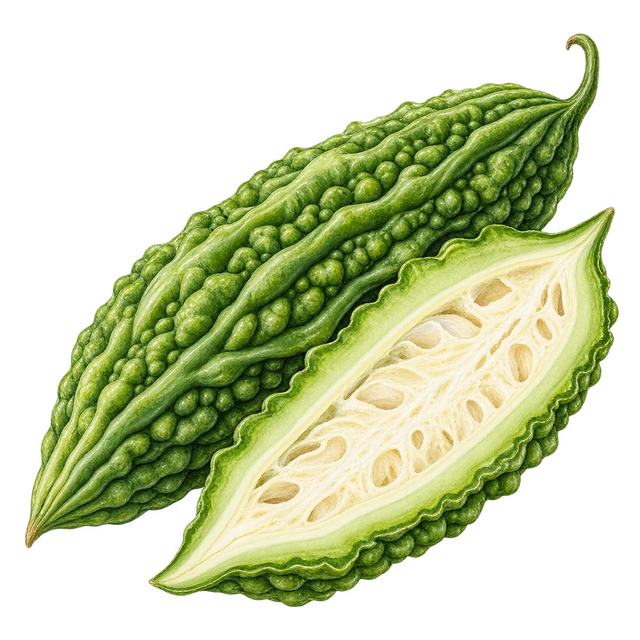
The cultivated bitter-melon vine’s immature fruit, used as a cooked vegetable after removing seeds and pith. This food card does not describe a seed, leaf-tea or concentrated-extract product.
Ingredient details, preparation and research
Also known as: Bitter gourd; Karela; Goya; Balsam pear; Bitter squash
Source plant or material
Momordica charantia L.
Plant family / material: Cucurbitaceae
Forms and route
Immature fruit cooked in savory dishes. Juice, dried powders and extracts differ from a vegetable serving.
Vitamins and minerals
Cooked bitter melon contributes vitamin C, folate, fiber and potassium. The UF/IFAS nutrient table refers to boiled, drained pods without salt, citing USDA FoodData Central 168394; it does not describe stir-fried fruit or juice. No numerical serving claim is used here.
Absorption and preparation
Vitamin C can improve absorption of nonheme iron from a meal. Heating and storage can reduce vitamin C, so a nutrient listing is not a guarantee of the amount retained or absorbed.
Practical preparation
Choose immature market fruit. Wash, halve and scoop out the seeds and spongy pith, then slice and cook. Salting followed by rinsing can soften the bitterness; this is a flavor step, not a safety test.
Combination context
Vitamin C-containing vegetables can accompany beans or other nonheme-iron foods; this does not treat an iron deficiency.
Combination notes
Pair with ordinary meal ingredients according to taste. Salted black beans and sauces add sodium; no herb combination is established here as a treatment.
Traditional and reported uses
- Stir-fries and spiced vegetable dishes
- Soups and stuffed fruit
- Documented traditional-use history
Contraindications and cautions
- Avoid bitter-melon supplements, extracts and medicinal juice during pregnancy; safety concerns include animal reproductive findings. Ask your maternity clinician about eating the cooked fruit; a safe pregnancy serving has not been established here.
- Bitter-melon preparations may add to the effects of insulin or other glucose-lowering medicines. Discuss medicinal use or a major intake change with your prescriber; do not adjust medication yourself.
- Remove and discard seeds. Do not substitute concentrated juice, seed preparations or extracts for ordinary food; adverse effects have been reported with these forms.
- Bitter melon is not a replacement for prescribed diabetes treatment. Stop using a preparation that causes significant symptoms and seek medical advice.
Similar items and how they compare
- Bitter-melon extract or juice
May come from the same species.
Concentration, plant part and preparation differ; clinical extract results do not establish a benefit or dose for cooked fruit.
- Cucumber
Both belong to the gourd family.
They are different plants. Bitter-melon handling or medicinal claims should not be transferred to cucumber.
Cooked food and extract trials answer different questions
A 2020 randomized trial studied an extract in adults with type 2 diabetes. Fasting glucose decreased, while HbA1c was unchanged over 12 weeks. This short extract trial cannot establish the effect of a cooked vegetable serving or justify replacing medication.
Pregnancy evidence has limits
LiverTox cautions against use in pregnancy because of potential abortifacient effects. Human pregnancy safety data do not establish a safe medicinal dose or a safe cooked-food threshold; absence of that threshold is not proof that an incidental meal causes harm.
Medication and preparation matter
MSK warns of additive effects with insulin and diabetes medicines and reports adverse events involving juice, extracts and seeds. Review the exact product with a clinician rather than treating every preparation as equivalent.
Nutrition is preparation-specific
The food-composition reference used here is a cooked, boiled, drained, unsalted form. Added oil, salted ingredients and portion size change the finished dish; a plant name alone cannot specify its nutrition.
Evidence limits
This is a food and heritage overview, not a dosing guide. Traditional reports and laboratory findings are not clinical recommendations. Medical evidence often concerns nonstandardized extracts; pregnancy safety and long-term effects remain uncertain.
Entry sources
- Kew POWO: Momordica charantia L.
- University of Florida IFAS: Bitter Melon—an Asian Vegetable Expanding in Florida
- Singapore National Parks Board: Momordica charantia, culinary uses
- Memorial Sloan Kettering: Bitter Melon, evidence and cautions
- NIH NIDDK LiverTox: Bitter Melon
- Kim et al. (2020): Randomized placebo-controlled bitter-melon extract trial
- Beloin et al. (2005): Ethnomedicinal uses of Momordica charantia in Togo
- NIH ODS: Vitamin C, health-professional fact sheet
- FDA: Selecting and Serving Produce Safely
Reference entry 247 · Recorded content review: 2026-10-09 · Review scope and dates