


Key cautions
- Not recommended as an everyday food or self-treatment.
- Most therapeutic research is preclinical and cannot establish benefit from homemade preparations.
What’s inside
Primary studies report phenolic acids, sterols including ergosterol, fatty acids and triterpenes including betulin and betulinic acid. Fruiting bodies and mycelial cultures can differ.
Uses in brief

- Balls for Sámi games
- Razor-strop material
- Historical folk-medicine infusions
History, folklore and reported uses
History, folklore and traditional uses
Two pieces of birch polypore on leather strips were among Ötzi’s equipment. Their presence is firm archaeological evidence; the purpose he intended is not. A possible medicinal interpretation should not become a confident story of a diagnosed illness and prescribed cure.
The fungus also belongs to material culture. Its common name recalls razor-strop use, while ethnobiological accounts describe elastic balls in particular Sámi games, including Inari Sámi and Lule River traditions. Those uses provide a fuller history than medicinal speculation alone.
A closer look at its history
The razor-strop fungus
Natural Resources Canada records the corky interior’s use for finishing knife edges, the origin of the razor-strop name. It also records tinder use. These tangible material properties offer a better-grounded unusual-use story than extrapolating laboratory antimicrobial assays into household wound treatment.
An archaeological object, not a diagnosed prescription
Pieces were found with Ötzi. Their presence is evidence that he carried the fungus, but does not by itself prove the popular claim that he was deliberately treating intestinal parasites. Keep the object and an interpretation of its purpose separate.
Additional history reviewed 2026-10-09
Traditional, historical and reported uses
- Balls for Sámi games
Food or household practiceWhy this label?
The claim documents balls for sámi games as a culinary, craft, gardening, or practical material use; it reports neither a treatment outcome nor measured nutrient content.
Documented Inari Sámi and Lule River traditions used birch polypore as a material for elastic play balls.
- Razor-strop material
Food or household practiceWhy this label?
The claim documents razor-strop material as a culinary, craft, gardening, or practical material use; it reports neither a treatment outcome nor measured nutrient content.
Its physical texture made it useful as razor-strop material, reflected in a common name.
- Historical folk-medicine infusions
Traditional accountWhy this label?
The claim reports European folk-medicine infusion practice, without asserting therapeutic benefit.
Northern and eastern European accounts describe infusions; these reports are historical practice rather than proof of therapeutic benefit.
- Historical wound coverings
Traditional accountWhy this label?
The claim reports traditional wound coverings and expressly does not establish sterility or clinical utility.
The fungus was used in wound-covering traditions. Raw fungal material is not a sterile medical dressing.
Four practical and historical uses are documented. Ötzi’s possession is discussed as archaeology, not counted as a proven medical use.
Story sources
- Review: Fomitopsis betulina, the Iceman’s polypore
- Natural Resources Canada: birch polypore and razor-strop use
- South Tyrol Museum of Archaeology: Ötzi’s equipment, birch polypore
- Lidström et al.: Sámi traditional sports and games
- Svanberg and Lidström: Viking Games and Sámi Pastimes
- Species Fungorum: Fomitopsis, Fomitopsidaceae
- Primary analysis: Chemical composition of Fomitopsis betulina fruiting bodies and mycelial cultures
Features and lookalikes to study
Fomitopsis betulina; formerly Piptoporus betulinus.
Common names vary between regions and suppliers; the scientific scope above governs this card.
Morphology described in sources
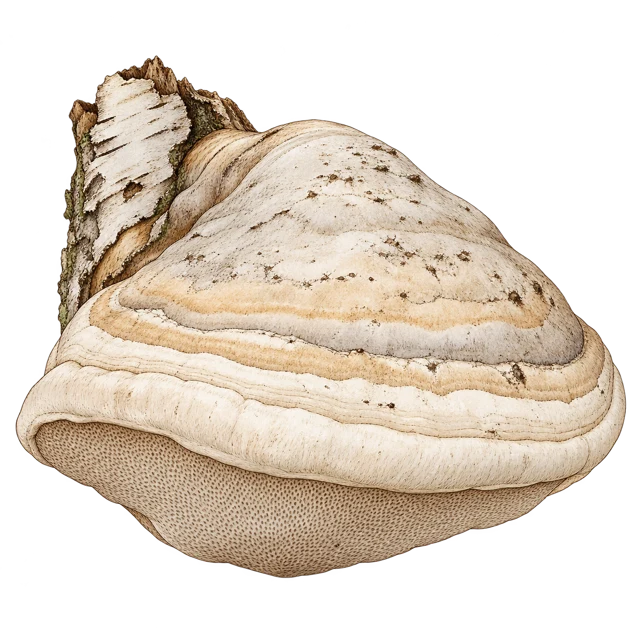
- F. betulina has a smooth pale-to-tan upper surface, a conspicuously rounded rim folding around the pale pore surface, white corky flesh, and a birch host. Its annual brackets can remain visible after they die.
- Habitat and substrate
- See the source-linked morphology and comparison notes below; a separate habitat summary has not been verified for this card.
- Geographic scope
- A complete regional range is not established here. Broad common names and commercial labels can span different species.
- Season in the cited region
- No region-specific fruiting season has been verified for this card. Do not infer a local season from trade availability.
Fomes fomentarius
Fomes is a perennial, generally hoof-like conk with brown tissue and tube layers. Birch polypore has white flesh and the characteristic rolled rim.
Both may occur on birch. Darkened old specimens and incomplete brackets reduce reliability; use a specialist when the complete character set is unclear.
Limits and regional differences
- Its older name Piptoporus betulinus is still common in archaeological and medical literature. A history of utility does not make a wild bracket appropriate to ingest or apply to wounds.
- Educational comparison only. Neither this card, an illustration, a photograph, a spore-print colour nor a checklist establishes that a wild collection is safe to eat. A qualified local mycologist must assess uncertain material; do not taste an unknown fungus. Cooking does not reliably eliminate mushroom toxins.
Identity & detailed reference
Identity
Fomitopsis betulina; formerly Piptoporus betulinus.
Ingredient details, preparation and research
Also known as: Birch polypore; Razor-strop fungus; Piptoporus betulinus
Source plant or material
Birch-associated fruiting bodies, historically used as worked material or folk-medicine preparations; culture extracts are a separate research material.
Fungal family: Fomitopsidaceae
Forms and route
Craft pieces, historical infusions and wound coverings; modern experimental extracts are not interchangeable with these.
Vitamins and minerals
Not presented as routine food or a dependable vitamin/mineral source. Chemical detection of a constituent does not establish a safe nutritional serving.
Absorption and preparation
Craft use relies on the fungus’s physical properties. Historical infusion and wound practices supply no validated home dosage, sterile dressing or general medicinal absorption protocol.
Traditional and reported uses
- Documented Inari Sámi and Lule River traditions used birch polypore as a material for elastic play balls.
- Its physical texture made it useful as razor-strop material, reflected in a common name.
- Northern and eastern European accounts describe infusions; these reports are historical practice rather than proof of therapeutic benefit.
- The fungus was used in wound-covering traditions. Raw fungal material is not a sterile medical dressing.
Contraindications and cautions
- Not recommended as an everyday food or self-treatment.
- Most therapeutic research is preclinical and cannot establish benefit from homemade preparations.
- Do not use unsterile fungal material on wounds.
Similar items and how they compare
- Tinder fungus / amadou
Both are bracket fungi with documented material-culture uses.
Tinder fungus supplies felt-like amadou; birch polypore has razor-strop and specifically documented Sámi ball-making histories.
Fungus, family and material
Fomitopsis betulina (formerly Piptoporus betulinus). Fomitopsidaceae. Birch-associated fruiting bodies, historically used as worked material or folk-medicine preparations; culture extracts are a separate research material.
- Review: Fomitopsis betulina, the Iceman’s polypore
- Natural Resources Canada: birch polypore and razor-strop use
- South Tyrol Museum of Archaeology: Ötzi’s equipment, birch polypore
- Lidström et al.: Sámi traditional sports and games
- Svanberg and Lidström: Viking Games and Sámi Pastimes
- Species Fungorum: Fomitopsis, Fomitopsidaceae
- Primary analysis: Chemical composition of Fomitopsis betulina fruiting bodies and mycelial cultures
Preparation and evidence
Craft use relies on the fungus’s physical properties. Historical infusion and wound practices supply no validated home dosage, sterile dressing or general medicinal absorption protocol.
- Review: Fomitopsis betulina, the Iceman’s polypore
- Natural Resources Canada: birch polypore and razor-strop use
- South Tyrol Museum of Archaeology: Ötzi’s equipment, birch polypore
- Lidström et al.: Sámi traditional sports and games
- Svanberg and Lidström: Viking Games and Sámi Pastimes
- Species Fungorum: Fomitopsis, Fomitopsidaceae
- Primary analysis: Chemical composition of Fomitopsis betulina fruiting bodies and mycelial cultures
Constituents and nutrition
Primary studies report phenolic acids, sterols including ergosterol, fatty acids and triterpenes including betulin and betulinic acid. Fruiting bodies and mycelial cultures can differ. Not presented as routine food or a dependable vitamin/mineral source. Chemical detection of a constituent does not establish a safe nutritional serving.
- Review: Fomitopsis betulina, the Iceman’s polypore
- Natural Resources Canada: birch polypore and razor-strop use
- South Tyrol Museum of Archaeology: Ötzi’s equipment, birch polypore
- Lidström et al.: Sámi traditional sports and games
- Svanberg and Lidström: Viking Games and Sámi Pastimes
- Species Fungorum: Fomitopsis, Fomitopsidaceae
- Primary analysis: Chemical composition of Fomitopsis betulina fruiting bodies and mycelial cultures
History and documented uses
Two pieces of birch polypore on leather strips were among Ötzi’s equipment. Their presence is firm archaeological evidence; the purpose he intended is not. A possible medicinal interpretation should not become a confident story of a diagnosed illness and prescribed cure. The fungus also belongs to material culture. Its common name recalls razor-strop use, while ethnobiological accounts describe elastic balls in particular Sámi games, including Inari Sámi and Lule River traditions. Those uses provide a fuller history than medicinal speculation alone.
- Review: Fomitopsis betulina, the Iceman’s polypore
- Natural Resources Canada: birch polypore and razor-strop use
- South Tyrol Museum of Archaeology: Ötzi’s equipment, birch polypore
- Lidström et al.: Sámi traditional sports and games
- Svanberg and Lidström: Viking Games and Sámi Pastimes
- Species Fungorum: Fomitopsis, Fomitopsidaceae
- Primary analysis: Chemical composition of Fomitopsis betulina fruiting bodies and mycelial cultures
Safety and interpretation
Not recommended as an everyday food or self-treatment. Most therapeutic research is preclinical and cannot establish benefit from homemade preparations. Do not use unsterile fungal material on wounds.
- Review: Fomitopsis betulina, the Iceman’s polypore
- Natural Resources Canada: birch polypore and razor-strop use
- South Tyrol Museum of Archaeology: Ötzi’s equipment, birch polypore
- Lidström et al.: Sámi traditional sports and games
- Svanberg and Lidström: Viking Games and Sámi Pastimes
- Species Fungorum: Fomitopsis, Fomitopsidaceae
- Primary analysis: Chemical composition of Fomitopsis betulina fruiting bodies and mycelial cultures
Entry sources
- Review: Fomitopsis betulina, the Iceman’s polypore
- Natural Resources Canada: birch polypore and razor-strop use
- South Tyrol Museum of Archaeology: Ötzi’s equipment, birch polypore
- Lidström et al.: Sámi traditional sports and games
- Svanberg and Lidström: Viking Games and Sámi Pastimes
- Species Fungorum: Fomitopsis, Fomitopsidaceae
- Primary analysis: Chemical composition of Fomitopsis betulina fruiting bodies and mycelial cultures
Reference entry 227 · Recorded content review: 2026-10-08 · Review scope and dates