


THE HERB NOTEBOOK · INGREDIENT 035
Peppermint essential oil
Concise binder companion · Entry 035
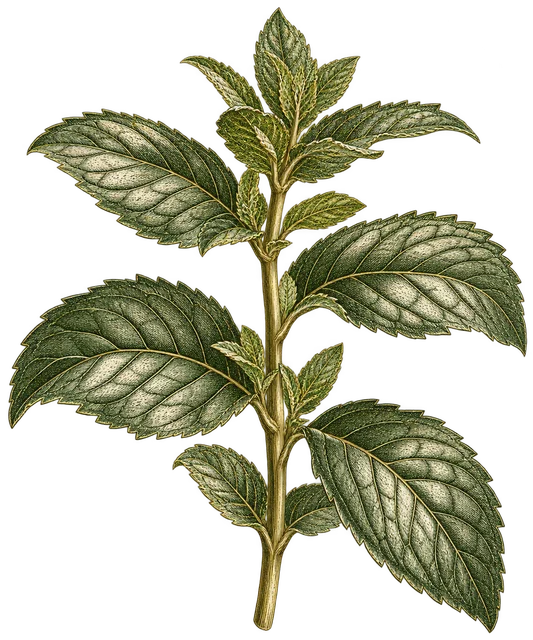
A selected guide to the plant, preparations, research, cautions and history. The complete reference remains available separately.
One plant, different preparations
Peppermint, Mentha × piperita, belongs to the mint family. Its essential oil is concentrated from the flowering plant and leaves. Peppermint leaf, a cup of leaf tea, distilled oil and a finished medicine are different preparations, even when they share the same familiar aroma. [1] [12]
Leaf and tea: plant material or a water infusion. Distilled essential oil: concentrated aromatic material. Enteric-coated capsules: manufactured oral products designed to delay release. Topical products: finished skin preparations with their own ingredients and directions. Results for one form cannot simply be assigned to another. [12]
This oil is not a serving of the leaf’s vitamins or minerals. Its familiar cooling character does not, by itself, show that a condition is being treated. [12]
Uses, traditions and research
Digestive comfort. Studies of enteric-coated peppermint oil suggest relief of overall symptoms and abdominal pain in some adults with irritable bowel syndrome. Results vary, and benefit is not certain for every product or person. This evidence concerns manufactured oral preparations, not drops taken from an aromatherapy bottle. [1] [12]
Tension-type headache. A small randomized crossover study involving 41 adults found that a specific topical peppermint-oil preparation reduced headache intensity compared with its placebo. The study addressed tension-type headache, not migraine. Its formulation is research context, not a home-mixing recipe. [3]
Traditional symptom relief. The European Medicines Agency records long-standing use of suitable peppermint-oil medicines for cough and cold symptoms, localized muscle pain and itching on intact skin. This is a traditional-use category, distinct from the monograph’s well-established medicinal uses. It does not mean that an oil treats an infection or the cause of pain. [2]
Hair-growth research. In a four-week mouse experiment, the peppermint-oil group showed stronger hair growth and changes in follicle measurements. These findings support further investigation; they do not establish treatment for human hair loss, superiority to minoxidil in people, or a safe scalp recipe. [4]
Mosquito-repellency research. A controlled experiment reported no mosquito landings for up to six hours with its tested peppermint-oil formulation. The result applies to that laboratory preparation and test conditions. It does not establish outdoor protection or disease prevention from arbitrary bottled oils, growing mint or homemade sprays. [5]
Other questions. Nausea studies and additional research contexts are discussed in the complete reference. This companion selects major themes rather than reproducing every study or claim. [12]
Cautions by product and person
Concentrated oil. Do not swallow oil sold for aromatherapy or substitute its drops for a medicinal capsule. Oil can irritate or burn the mouth, skin and eyes. Store it out of children’s reach; obtain poison advice after an accidental ingestion or concerning exposure. [8] [12]
Skin and scalp products. Irritation, rash or allergy can occur. Keep oil away from eyes, mucous membranes and damaged skin. Stop a product that causes burning or rash. Menthol-rich oil must be kept away from infants’ and young children’s faces because it can affect breathing. [1] [12]
Digestive medicines. The EMA monograph excludes medicinal gastrointestinal oil use with liver disease, gallstones or other bile-duct disorders, and absent stomach acid. Reflux or a hiatal hernia may worsen. Product-specific eligibility and instructions matter. [2]
Capsules and other medicines. Swallow gastro-resistant capsules whole. Food timing, antacids and acid-suppressing medicines can affect release. A pharmacist can check the actual product alongside existing medicines; do not change prescribed treatment independently. [6] [7]
Allergies and other ingredients. Avoid a product containing an ingredient to which you are allergic. The reviewed UK Colpermin product contains peanut oil and its label also advises people with soya allergy to avoid it. These warnings belong to that product, not to every peppermint preparation. Check the current local label. [7]
Children. Eligibility differs by route and product. EMA contraindicates traditional oil medicines under age two and in children with a seizure history. The complete reference retains the more detailed age distinctions; an adult dose must not simply be scaled down. [2] [12]
Pregnancy and breastfeeding. Concentrated medicinal products are not equivalent to ordinary food amounts. The reviewed UK Buscomint label advises against use in pregnancy and says not to use while breastfeeding. Seek product-specific advice rather than assuming that all peppermint forms share the same safety profile. [6]
Fields, stills and the peppermint trade
Peppermint’s story includes growers and distillers as well as household remedies. In 1792, Daniel Lysons described more than 100 acres of peppermint around Mitcham, south of London, within roughly 250 acres of medicinal crops. Merton Historical Society preserves this account of a local industry supplying both apothecaries and peppermint cordial. [9]
The story helps separate the plant from its products: a harvested leaf, distilled fragrance and formulated medicine travel through different processes. Distillation made the plant’s aroma portable, but it did not make all preparations interchangeable. [12]
Mint in Scripture and language
“Woe unto you, scribes and Pharisees, hypocrites! for ye pay tithe of mint and anise and cummin, and have omitted the weightier matters of the law, judgment, mercy, and faith: these ought ye to have done, and not to leave the other undone.” Matthew 23:23, KJV. [10]
Mint belongs to Jesus’ illustration of priorities: careful attention to small offerings does not replace judgment, mercy and faith. This is a Scripture and cultural connection, not a medical claim or identification of distilled peppermint oil. The verse does not specify the modern peppermint hybrid. [10] [12]
The Greek word ἡδύοσμον, transliterated hēdýosmon, is associated with sweet fragrance. Its name describes scent rather than proving a healing property. [11]
A few useful terms
Enteric-coated or gastro-resistant: made to delay release until after the stomach. Excipients: other ingredients in a finished product. Preclinical: research before testing in people; the hair study here used mice. Very low certainty: substantial uncertainty about an estimated effect, not proof that nothing happens. [12]
Educational reference. Suitability depends on the product and the person. The complete reference contains additional research, preparation details, cautions and source links. This companion does not replace individualized medical advice or emergency care. [12]
Sources

- NCCIH: Peppermint Oil
- EMA: Peppermint oil herbal monograph, Revision 1 (2020)
- Göbel et al. (1996): tension-type headache trial
- Oh et al. (2014): peppermint oil and hair growth in mice
- Lalthazuali and Mathew (2017): controlled mosquito-repellency experiment
- Buscomint: UK Summary of Product Characteristics
- Colpermin: UK Summary of Product Characteristics
- National Capital Poison Center: Peppermint oil
- Merton Historical Society: Mitcham Herbal Industries
- Matthew 23:23, King James Version
- Thayer’s Greek Lexicon: mint, G2238
- The Herb Notebook: complete peppermint essential oil reference