No herb, spice, vitamin, mineral or plant food was identified with reliable human evidence to treat testicular cancer, reverse torsion or repair a serious testicular injury. This card keeps that gap clear.
Testicular cancer, torsion, injury and new scrotal symptoms. Fertility and sperm measurements are separate topics and do not establish treatment of these conditions.
Decorative topic illustration.
Care basics come first
Have a new lump, swelling, size change or persistent discomfort checked promptly.
There is no standard routine screening test for testicular cancer in people without symptoms. A new lump still needs assessment.
Cancer treatment depends on the cancer type and stage. Options can include surgery, chemotherapy, radiotherapy or planned surveillance.
If cancer treatment may affect future fertility, discuss sperm banking with the care team before treatment where possible.
How we chose these entries
Zero disease-treatment materials are listed. Generic antioxidants and fertility products were not added to create a list of 20.
No defensible positive herb/food/nutrient treatment set was found for these testicular diseases in the reviewed clinical guidance and research. This is an evidence gap, not a claim that every possible material has been disproved. Animal antioxidant experiments and male-fertility biomarker studies were deliberately excluded.
The testicles, also called testes, are two organs that usually sit in the scrotum. The scrotum is the loose skin pouch below the penis. It is normal for one testicle to hang a little lower or be slightly larger than the other.
The testicles make sperm, the cells that can join with an egg to start a pregnancy. They also make testosterone, a hormone needed for sperm production and sexual development.
Behind each testicle is a soft, coiled tube called the epididymis. Sperm mature there before moving through other tubes. This normal tube is a different structure from the testicle itself. A new lump or change still needs a medical check.
Wash the outside of the scrotum and nearby groin gently each day with warm water. If you use a cleanser, choose a mild, unperfumed one. Rinse it away and pat the skin dry with a soft towel.
Avoid hard scrubbing and repeated washing. Genital skin is delicate. Perfumed soaps, deodorants and strong antiseptics can irritate it. If soap stings or the skin is dry, ask a pharmacist or clinician about a plain soap substitute.
Wear clean, comfortable underwear. Change out of damp or sweaty clothes. Choose clothing that does not rub or trap moisture; loose cotton underwear may help if the skin is irritated.
Removing pubic hair is not needed for cleaning. Shaving can cause small injuries and irritation.
Washing cleans the outer skin. The testicles inside the scrotum do not need internal washing or a detox.
Do not use essential oils or homemade herbal mixtures as genital cleansers. These products can irritate sensitive skin, and they are not proven to clean or protect the testicles. Tea tree oil, for example, can cause skin redness and irritation.
A wash or supplement cannot untwist a testicle, repair a serious injury or replace treatment for cancer or an infection.
Wear a properly fitted athletic cup for contact sports or other sports with a risk of a hit to the groin.
The scrotum helps keep the testicles cooler than the inside of the body. Too much heat can affect sperm production. If you are trying for a pregnancy or have a fertility problem, ask your clinician about avoiding frequent hot tubs or saunas and keeping hot laptops off your lap.
These steps do not guarantee fertility. Sperm count and pregnancy are different outcomes. Do not try heating or icing the testicles to improve fertility or as birth control; follow medical advice for any injury.
Notice changes in how your testicles look and feel. During a warm shower, gentle handling can help you learn your usual shape and the soft tube behind each testicle. Do not squeeze hard or keep checking a sore area.
Advice about regular checks differs. The NHS suggests checks about once a month. The US Preventive Services Task Force advises against routine cancer screening, including scheduled self-exams, in people without symptoms because a health benefit has not been shown.
Screening advice does not mean you should ignore symptoms. Ask a clinician about your own risk and whether planned checks are right for you, especially if you have had an undescended testicle.
Get emergency care now for sudden, severe testicle pain. Also seek emergency care for testicle pain with nausea, vomiting or belly pain, or pain lasting more than an hour or continuing at rest. Do not wait an hour if the pain is sudden or severe.
A twisted testicle, called torsion, can lose its blood supply. It needs urgent hospital treatment. Do not wait for a home remedy to help.
Arrange a prompt medical check for a new lump, swelling, a change in size or feel, or ongoing discomfort. Many changes have causes other than cancer, but an exam is needed to tell. New pain after a groin injury also needs assessment.
These references concern the scrotum, the outer skin pouch around the testicles. They do not describe treatments for the testes inside it.
For dry or irritated genital skin, clinical guidance favors bland emollients and gentle washing with an emollient soap substitute. Avoid fragrance, deodorants, harsh antiseptics, talcum powder, scrubbing and repeated washing. Comfortable clothing can reduce rubbing.
Persistent itching, a rash, sores or discharge needs assessment: eczema, allergy and infection can look similar. A clinician should guide any steroid or other medicated genital treatment.
Get emergency care for sudden severe testicle pain, pain with nausea or vomiting, or pain lasting more than an hour or continuing at rest. Do not wait if pain is sudden or severe. New lumps or swelling need a prompt medical check.
Seek emergency care for rapidly worsening painful swelling or skin changes with fever, or severe pain out of proportion to the visible rash.
No records match. Try another name or clear the filters.
Scrotal skin: external care references
These records concern the outer skin pouch, not the testes inside it. Read the specific setting, formulation and limits.
External skin-care reference
Plain petrolatum: external skin barrier
Decorative illustration; not an identification reference. Generic format context; actual studied or finished product not shown.
Purified petrolatum; not a plant ingredient
Form
Plain, fragrance-free petrolatum ointment
How it is used
topical, external scrotal skin only
Evidence
Scrotum-specific clinical commentary; not a controlled trial
A bland barrier option discussed in clinical guidance for scrotal itch.
Condition and setting
External scrotal skin: supportive care for dryness or irritation; diagnosis-specific treatment remains separate
Cautions
Ask a clinician about a persistent or new genital rash rather than treating it as simple dryness.
Petrolatum is oil-based and can damage latex condoms. Check product and condom compatibility; it is not a condom lubricant.
Emollient residue on clothing and bedding increases fire risk. Keep away from smoking and naked flames.
Why no exact ingredient link?
Standalone care reference; do not create a botanical card or substitute a plant oil.
Evidence, limits and sources for Plain petrolatum: external skin barrier
What was found
A 2022 Cutis editorial describes plain petrolatum for scrotal itch when irritation or contact allergy contributes. It forms a barrier that retains moisture and limits contact with irritants. DermNet separately recommends emollients and barrier care for diagnosed scrotal lichen simplex.
What this does not show
Supportive skin care does not identify or treat every cause of itching. This is not evidence of benefit to the testicles, hormones or fertility. Do not stop prescribed treatment on the basis of this entry.
Exact ingredient
Standalone care reference; do not create a botanical card or substitute a plant oil.
Why we included it
Provides a plain non-botanical barrier reference with explicit scrotum-specific clinical commentary and clear limits.
Decorative illustration; not an identification reference. Generic format context; actual studied or finished product not shown.
Zinc oxide ingredient in a finished barrier cream or ointment
Form
Finished bland skin-barrier product; not powder, oral zinc or sunscreen
How it is used
topical, external skin only
Evidence
General barrier guidance applied with explicit limits; no scrotal-specific zinc trial identified
Zinc oxide is a conventional barrier ingredient; genital suitability depends on the finished product.
Condition and setting
External scrotal skin: supportive care for dryness or irritation; diagnosis-specific treatment remains separate
Cautions
Ask a pharmacist or clinician which finished product is suitable for genital skin; fragrances and preservatives can irritate.
Do not apply loose zinc oxide powder or a homemade mixture. Most barrier creams are not intended for open or broken skin.
Stop if irritation worsens. Check whether an ointment affects latex condoms.
Why no exact ingredient link?
Related ingredient profile only. The catalog ingredient is not an exact match to every finished barrier formulation.
Evidence, limits and sources for Zinc oxide: barrier-product context
What was found
DermNet lists zinc oxide among barrier ingredients. Its scrotal lichen simplex guidance includes barrier care but does not identify zinc oxide as superior or test a particular zinc product. Guidance for incontinence-related genital irritation also supports barrier care without establishing a best product.
What this does not show
This is an ingredient-level connection to barrier care, not direct evidence that zinc oxide treats an undiagnosed scrotal rash. It does not treat fungal or sexually transmitted infections or benefit the internal testes.
Exact ingredient
Related ingredient profile only. The catalog ingredient is not an exact match to every finished barrier formulation.
Why we included it
Connects the existing topical zinc-oxide profile to general barrier care while explicitly distinguishing ingredient-level guidance from scrotal-specific efficacy evidence.
Related material only
These are different ingredients or forms. Do not assume the same findings apply to them.
These historical reports or laboratory findings do not establish a clinical benefit.
Traditional reports
Cnidium monnieri fruit: documented traditional use
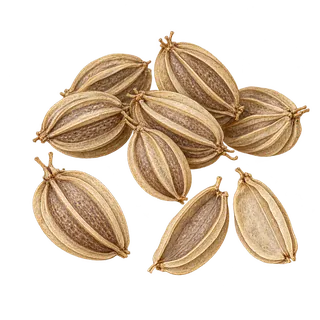
Decorative illustration; not an identification reference. Fruit appearance only; no decoction recipe, dose or actual studied preparation shown.
Cnidium monnieri (L.) Cusson. · Fruit
Form
Fruit decoction recorded in an ethnobotanical survey; no recipe provided
How it is used
Reported oral and medicinal-bath routes; not separated by individual condition
Evidence
Primary ethnobotanical survey; reported traditional use, not clinical evidence
A 2020 Mulam ethnobotanical survey records Cnidium monnieri fruit in traditional use for scrotal eczema.
Condition and setting
Scrotal eczema in a traditional-use record; no cancer claim
Cautions
Historical context only. Do not use this entry as a recipe or a recommendation to swallow the plant or apply it to genital skin.
Why no exact ingredient link?
No exact ingredient-card match verified; retained only as a topic-context historical record.
Evidence, limits and sources for Cnidium monnieri fruit: documented traditional use
What was found
Hu and colleagues documented plant uses among Mulam communities in Luocheng County, Guangxi, China, during 2013–2017. Table 2 lists fruit decoction with oral and medicinal-bath routes for several conditions including scrotal eczema.
What this does not show
The table does not separate the routes by individual condition. This survey documents reported practice; it does not establish clinical benefit or safety for scrotal skin.
Exact ingredient
Topic-only historical reference; no exact existing ingredient-card match verified.
Why we included it
Provides a scrotal-skin-specific documented traditional-use reference without conflating hydrocele, testicular swelling, or fertility with skin care.